Play 2048 Online
Slide numbered tiles on a 4×4 grid. When two tiles with the same number collide, they merge into one. Reach the 2048 tile to win — then keep going for a high score.
Created by Brian Hamilton
How to play 2048
Slide the tiles, combine matching numbers, and try to build a 2048 tile.
- Every move slides all tiles as far as they will go in that direction.
- Two tiles with the same number that collide combine into one worth double, and that amount is added to your score.
- A tile made by a merge cannot merge again on the same move.
- After every move that changes the board, a new tile appears on a random empty square — a 2 nine times out of ten, a 4 otherwise.
- The game ends when the board is full and no two neighbours match.
Controls: arrow keys or WASD on a keyboard, or swipe on a touchscreen. Undo takes back the last move.
The rule that decides every game
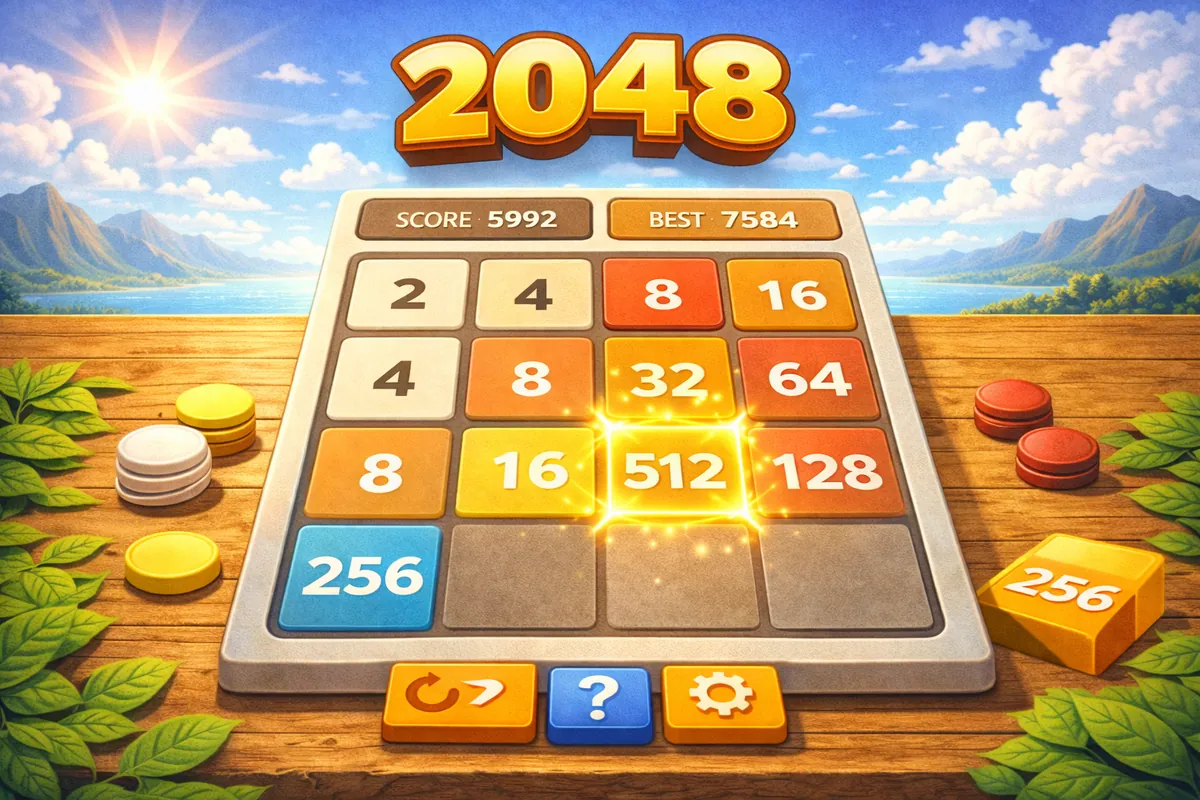
Slide the board and equal tiles combine. The detail that governs everything else is this: a tile produced by a merge is finished for that move. Slide 2 2 4 to the left and you get 4 4, never a single 8. The new 4 cannot immediately swallow the old one.
That single restriction is why the board fills up. If merges cascaded, a tidy row would collapse to one tile and space would look after itself. Instead every doubling costs a separate move, and the board is always racing the tile that appears after each one.
Reaching 2048 is harder than it looks
It is worth knowing what you are up against. Five automated strategies played 1,720 games on this exact board, and not one of them reached 2048. Not rarely — never. Repeating the whole exercise on three separate runs of random seeds gave the same answer every time.
| Strategy | Median score | Best score | Usual finish |
|---|---|---|---|
| Random moves | 1,064 | 3,184 | 128 |
| Never press up | 2,408 | 7,644 | 256 |
| Take the most points | 2,956 | 12,480 | 256 |
| Positional weighting | 3,148 | 13,080 | 256–512 |
| Positional + one move of lookahead | 3,236 | 14,072 | 256–512 |
The pattern is the interesting part. Going from random flailing to any deliberate rule roughly triples your score. Going from one deliberate rule to a better one barely helps at all — a few per cent. Everything simple plateaus in the same place, somewhere around 256 to 512.
“Never press up” does not survive measurement
The most repeated piece of 2048 advice is to pick a corner, keep your largest tile there, and never press the direction that would dislodge it. As a strict rule — always play left, then down, then right, and up only when nothing else moves — it scores a median of 2,408, against 2,956 for simply taking whichever move scores most this turn. It came out behind on all three runs.
The idea behind the advice is sound; the absolute version of it is not. Refusing a direction outright means walking into positions a single upward move would have resolved, and the cost of those exceeds the benefit of a tidy corner. Treat it as a strong preference, not a prohibition.
The useful version: keep your largest tile in a corner and the row beneath it in descending order, so merges chain along one edge. Break the rule when the alternative is a board you cannot move — a stranded position costs more than one untidy row.
What actually separates 512 from 2048
Not a better rule of thumb. Depth. Every strategy measured above looks at most one move ahead, and they all stall in the same place. The programs that do reach 2048 reliably — and go well beyond it — search six or more moves deep, averaging over where each random tile might land at every level. That is a different kind of thing from a heuristic, and it is not something a person does at speed.
Which is the honest encouragement: if you are stalling around 512, you are performing about as well as every simple automated strategy tested here. The way past it is planning several moves ahead in specific positions, not a rule you can apply everywhere.
Practical habits that move the number
Count your empty squares, not your points. The score is a lagging indicator. Empty cells are the resource that actually runs out, and every game ends the same way: no empty cells and no equal neighbours.
Build along one edge. Merges chain when equal tiles are adjacent, so keeping large tiles in descending order along a single row or column means one slide can trigger several merges at once.
Watch for the checkerboard. The board is dead when no two neighbours match — a perfect alternating pattern is the worst case. If your tiles are becoming interleaved rather than grouped, that is the warning sign, several moves before you actually get stuck.
A 4 is not a bonus. One tile in ten arrives as a 4 rather than a 2. It looks like a head start and is usually a nuisance, because it cannot pair with the 2s that make up most of the board.
What was verified on this page
Sliding and merging were checked against an independently written implementation on every one of the 1,296 possible rows over six distinct tile values, and then across 240,000 randomly generated board-and-direction pairs in all four directions. The resulting board, the score awarded, and the judgement of whether anything moved all agree everywhere.
Game-over detection was checked on 320,000 boards, including 200,000 completely full ones where the answer turns entirely on whether any two neighbours match — the case that decides whether a game ends correctly. It never ends a playable board and never lets a dead one continue.
The spawn was measured over 300,000 tiles: 10.08% are 4s, matching the standard game's one-in-ten, and the position is uniform across the empty cells to within 1.6%. A tile never appears on an occupied square.
Where the game came from
2048 was written in a weekend in March 2014 by Gabriele Cirulli, then nineteen, as a variation on two earlier games with the same sliding mechanic. He released it free and open source, and it spread far enough that he has described being slightly baffled by it. Its staying power comes from the shape of the difficulty curve: the first few hundred points arrive almost by accident, and every doubling after that costs disproportionately more.
More puzzles like this
If you like games where space is the real constraint, try these:
Reversi
Classic disc-flipping strategy game — play vs AI or a friend.