Number Puzzles Online — Free Number Puzzles to Play in Your Browser
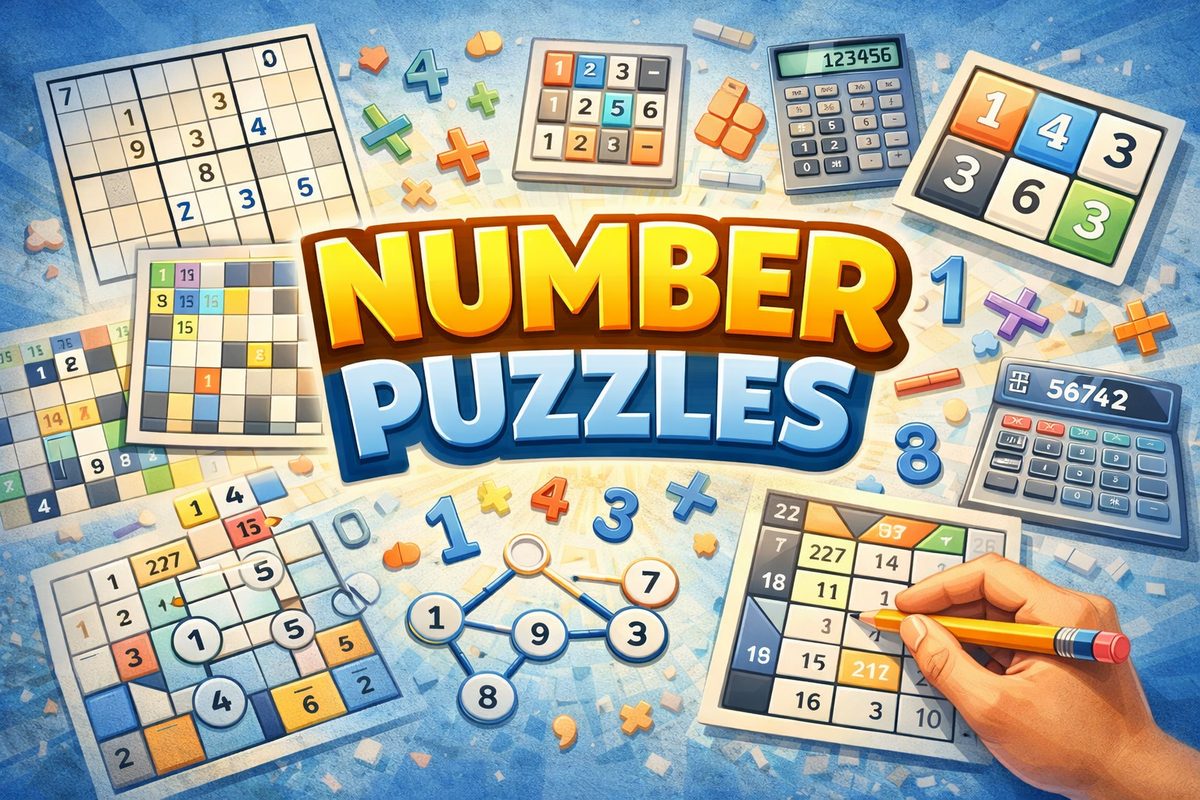
Number puzzles — games where digits, arithmetic, and logical reasoning collide — are among the most played puzzle types on the planet. From the worldwide phenomenon of Sudoku to the fast-paced tile-sliding of 2048, number puzzles offer an enormous range of challenge and style. Some demand careful deduction on a grid; others test quick mental arithmetic; still others blend numbers with spatial thinking in ways that feel entirely fresh.
The best part? You can now play dozens of number puzzles online for free. No downloads, no sign-ups — just open your browser and start solving. Below you'll find over 30 number puzzle types organized into clear categories, each with a short explanation of how it works. Wherever we offer a free browser version, there's a direct link so you can jump straight in.
What Are Number Puzzles?
A number puzzle is any puzzle whose primary elements are digits or numerical values. The genre is vast: it includes classic grid-based deduction puzzles (like Sudoku), arithmetic-driven challenges (like Kakuro and KenKen), sliding-tile games (like 2048), codebreaking games (like Bulls & Cows), and many more.
What most number puzzles share:
- Digits as the core mechanic — you place, move, combine, or deduce numbers.
- Logical reasoning — the best number puzzles reward deduction over guesswork.
- Simple rules — most can be explained in a few sentences, yet depth emerges from constraint interaction.
- Scalable difficulty — grid size, clue density, or added rules let designers tune the challenge from relaxing to brutal.
Whether you're a Sudoku veteran or someone who's never tried a Kakuro, this guide has something for you. Let's dive in.
Puzzle Categories
We've organized number puzzles into five broad families. Click a category to jump straight to it:
- Grid Placement Puzzles — fill grids with digits following uniqueness or positional rules
- Arithmetic & Sum Puzzles — digits must satisfy addition, multiplication, or other math operations
- Counting & Clue-Based Puzzles — numbers act as clues telling you about surrounding cells
- Elimination & Deduction Puzzles — remove, shade, or deduce digits through constraints
- Action & Sliding Number Puzzles — move, merge, or manipulate number tiles in real time
1. Grid Placement Puzzles
The heart of the number puzzle world. In these puzzles you're given a grid — sometimes with a few numbers pre-filled — and your job is to complete it so every digit respects the rules. No advanced math necessary; it's all about logical elimination and pattern recognition.
Sudoku
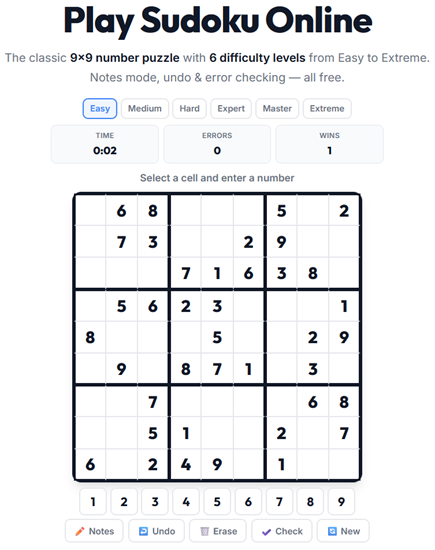
The undisputed king of number puzzles and the world's most popular logic game. Fill a 9×9 grid so that every row, every column, and every 3×3 box contains the digits 1–9 exactly once. No arithmetic required — it's pure placement logic. Sudoku was popularized by the Japanese publisher Nikoli in the 1980s and exploded into a global phenomenon in the mid-2000s. Difficulty ranges from gentle warm-ups to diabolical grids requiring advanced techniques like X-Wing, Swordfish, and chaining.
Futoshiki
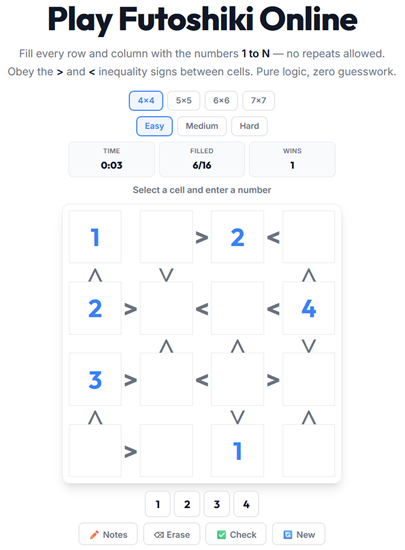
The name means “not equal” in Japanese. Fill an n×n grid with digits 1–n so that no number repeats in any row or column. The twist: inequality signs (< and >) between certain cells tell you which digit must be larger. Futoshiki is a fantastic entry point to number grid puzzles — the rules are dead simple, but harder grids require careful chain reasoning to crack.
Skyscrapers
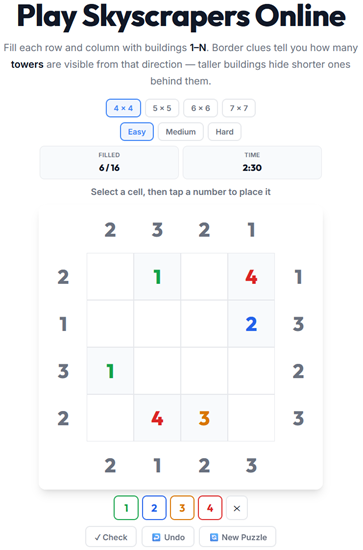
Imagine looking at a city skyline from the edge of a grid. Each cell contains a “building” of height 1–n, with no height repeated in any row or column. Clues around the border tell you how many buildings are visible from that direction — taller buildings block shorter ones behind them. Skyscrapers blends spatial visualization with number-placement logic in a way that feels unlike any other puzzle.
Suguru (Tectonics / Number Blocks)
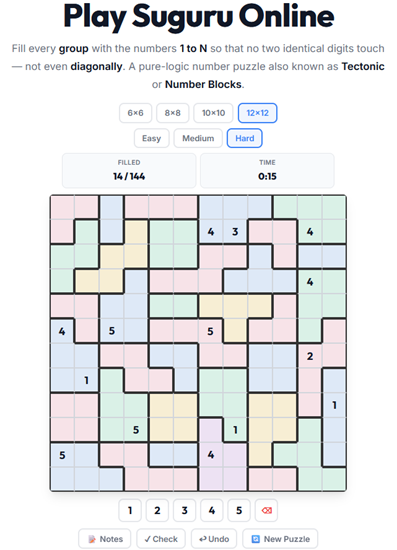
The grid is divided into irregular regions of varying sizes. Fill each region with the digits 1 through n, where n is the number of cells in that region. The catch: no two identical digits can be adjacent — not even diagonally. Suguru puzzles are compact and quick at easy levels, but the adjacency constraint creates deceptively deep logic at harder difficulties.
Fillomino (Polyominous)
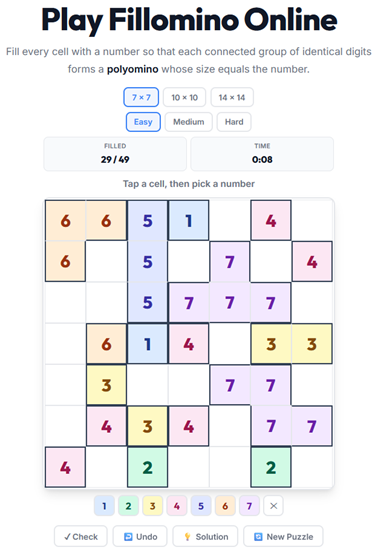
Fill every cell with a number so that each group of connected cells sharing the same number forms a polyomino (a contiguous block) whose size equals that number. For example, a group of 4s must cover exactly four connected cells. Some clue numbers are given; the rest you deduce. Unlike most number puzzles, Fillomino doesn't have fixed regions — you discover them as you solve, which gives it a uniquely exploratory feel.
Takuzu (Binary / Binairo)
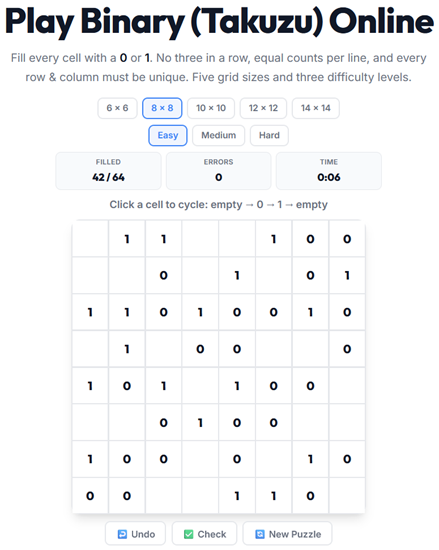
Fill a grid with 0s and 1s. Each row and column must contain an equal number of each digit, no three consecutive cells in a line can be the same, and no two rows (or columns) can be identical. Takuzu is a perfect “palette cleanser” — fast, clean, and oddly addictive. It's also known as Binairo, Binary Puzzle, or Tohu wa Vohu.
Hidato (Number Snake)
Fill a grid with consecutive integers starting from 1 so that each number is orthogonally or diagonally adjacent to the next. A few numbers are given as anchors. The result is a continuous path that snakes through every cell. Hidato is approachable and satisfying — it's essentially a logic-driven connect-the-dots for adults. Invented by Israeli mathematician Gyora Benedek.
Numbrix
Very similar to Hidato, but with one key difference: consecutive numbers must be orthogonally adjacent only (no diagonals). This tighter constraint makes the path-finding logic quite different. Numbrix was popularized by Parade Magazine and is a great alternative for solvers who find Hidato too forgiving.
Str8ts
Fill the white cells of a 9×9 grid with digits 1–9. Each row and column is broken into “compartments” by black cells, and the digits in each compartment must form a straight — a set of consecutive numbers in any order (like 3, 5, 4). No digit can repeat in a row or column. Str8ts feels like a cousin of Sudoku but with a completely different solving flavor thanks to the consecutive-set mechanic.
Kropki
Fill a Latin square grid with 1–n. Between some pairs of adjacent cells you'll see dots: a white dot means the two digits are consecutive, a black dot means one digit is double the other. If there's no dot, neither condition holds. Kropki is a favorite on the competitive puzzle circuit for its clean constraint-based reasoning and elegant dot mechanic.
2. Arithmetic & Sum Puzzles
These number puzzles add a layer of arithmetic to the logic. You're not just placing digits — they need to add up, multiply, or otherwise satisfy mathematical relationships. Don't worry, nothing beyond basic operations is required; the challenge is in how the constraints interact.
Kakuro
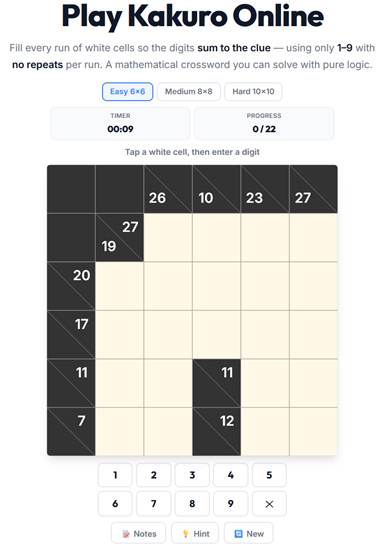
Often called a cross-sum or number crossword, Kakuro uses a crossword-style grid where each “run” of white cells must add up to the clue shown at its start. Digits 1–9 can each appear only once per run. It blends the satisfaction of Sudoku with light arithmetic, and it's been a staple of every serious puzzle magazine since Nikoli popularized it in the 1980s under the name “Kasan Kurosu.”
Sumplete
Kakuro turned inside out: every cell already holds a number, and instead of writing digits in you delete them, until what is left in each row and column adds up to the target at its edge. Repeated numbers are allowed, and they are what make the bigger boards hard — a row cannot tell two 9s apart, only its columns can. The rules appeared in the apps Rullo and Summer before Sumplete made them famous in 2023.
KenKen
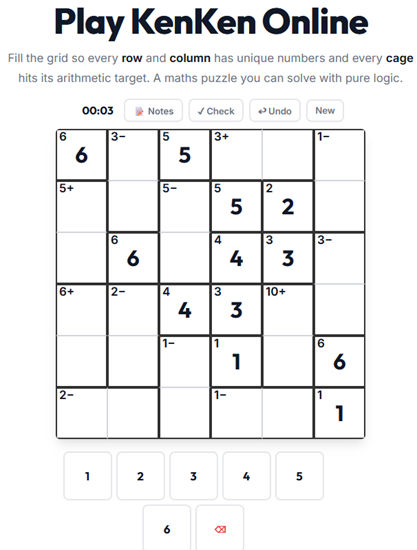
Invented by Japanese math teacher Tetsuya Miyamoto, KenKen asks you to fill an n×n grid with 1–n so that no digit repeats in any row or column. Groups of cells (“cages”) are marked with a target number and an arithmetic operation (+, −, ×, ÷) that the digits inside must satisfy. KenKen is a brilliant crossover of Sudoku-style placement logic and basic arithmetic, and it's a proven classroom tool for making math fun.
Killer Sudoku
A hybrid of Sudoku and Kakuro that has earned its own massive following. Standard Sudoku rules apply (1–9 in every row, column, and 3×3 box), but instead of given digits you get dashed cages with sum totals. Digits within a cage must add up to its total and cannot repeat. Killer Sudoku regularly appears in the World Puzzle Championship and is sometimes called “Sum Sudoku” or “Samunamupure.”
Calcudoku
Very similar to KenKen, but with a key difference: digits can repeat within a cage (as long as they don't repeat in a row or column). This subtle change opens up harder deductions and makes Calcudoku a favorite in competitive puzzle circles. Sometimes published under the name “Calkuro.”
Magic Squares
One of the oldest number puzzles in history, dating back thousands of years to ancient China. Arrange the numbers 1–n² in an n×n grid so that every row, every column, and both main diagonals sum to the same magic constant. The classic 3×3 magic square (using 1–9 with a magic sum of 15) is simple to memorize, but larger squares and variant forms (bordered, pandiagonal, multiply magic) offer genuine depth.
Cross-Number Puzzles
Like a crossword, but every answer is a number. Clues describe mathematical relationships (“A perfect square less than 50”, “The sum of its digits is 12”) and you fill the grid with digits. Cross-number puzzles have been a feature of math magazines and puzzle competitions for decades and test both arithmetic fluency and logical deduction.
Sujiko
Place the digits 1–9 in the cells of a 3×3 grid (with one cell pre-filled). At each of the four interior intersections, a number tells you the sum of the four cells that meet at that point. Sujiko is bite-sized and satisfying — solving one takes just a few minutes but exercises the same deductive muscles as larger puzzles.
Suko starts with that same 3×3 number set and four-circle geometry, then adds a second set of totals for coloured groups of cells. Those colour clues cross the circle clues, creating another route into each deduction.
3. Counting & Clue-Based Number Puzzles
In these puzzles, numbers don't need to be placed — they're already on the grid, serving as clues. The numbers tell you something about adjacent cells: how many mines are nearby, how many segments to shade, how many bridges to build. Your job is to use those numeric clues to deduce the solution.
Minesweeper (as a Puzzle)
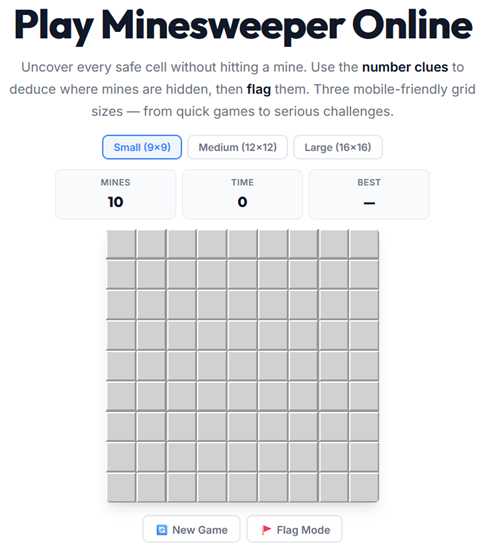
The classic computer game works perfectly as a pure number puzzle. Each revealed number tells you how many mines sit in its adjacent cells. In the puzzle version there's no luck involved — every mine can be logically deduced from the number clues alone. Minesweeper puzzles appear in puzzle competitions worldwide and are a fantastic introduction to constraint-based number reasoning.
Hashi (Hashiwokakero / Bridges)
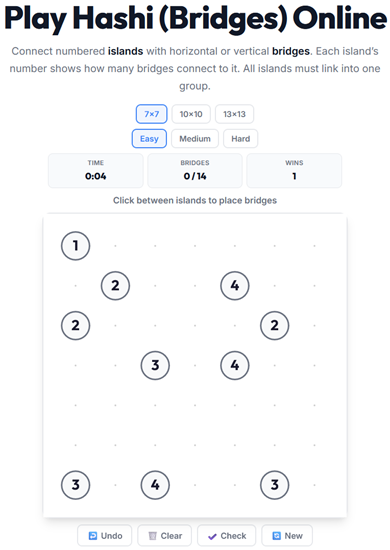
Numbered circles (“islands”) sit on the grid. Connect them with horizontal or vertical bridges (one or two between any pair). Each island's number equals its total bridge count. All islands must be connected into a single network, and bridges can't cross. Hashi is beautifully tactile and one of the best “gateway” number puzzles for beginners — the numbers guide everything.
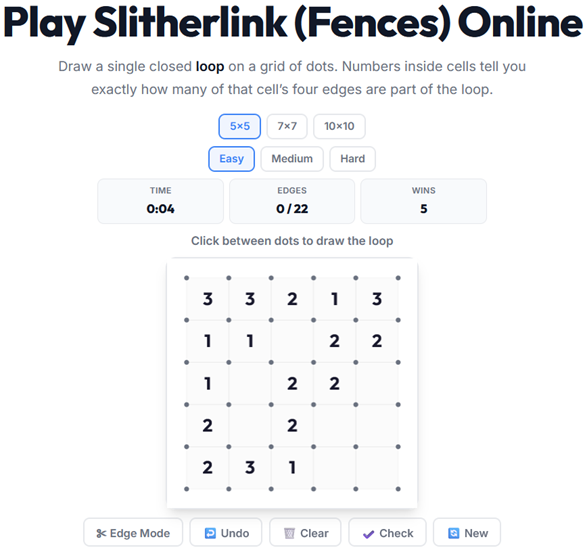
Slitherlink (Fences / Loop the Loop)
Draw a single non-crossing, non-branching loop along the edges of a square grid. Some cells contain a number (0–3) that tells you exactly how many of that cell's four edges are part of the loop. The numbered clues drive all of the logic. Slitherlink is one of Nikoli's greatest hits and a staple of the World Puzzle Championship.
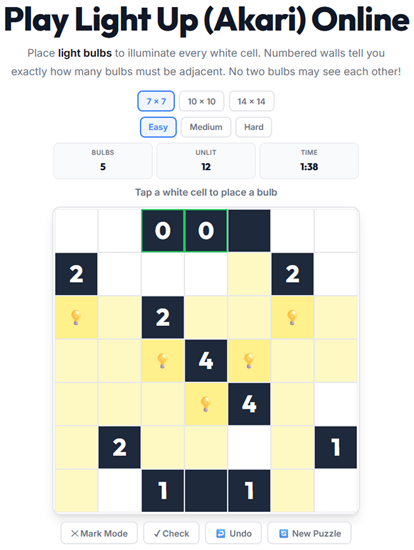
Light Up (Akari)
Place light bulbs on the grid to illuminate every white cell. A bulb lights its entire row and column until blocked by a black wall. No bulb can shine on another. Numbered walls are the key mechanic — a number on a wall tells you exactly how many of its orthogonal neighbors are bulbs. Light Up is one of the most intuitive number-driven puzzles around.
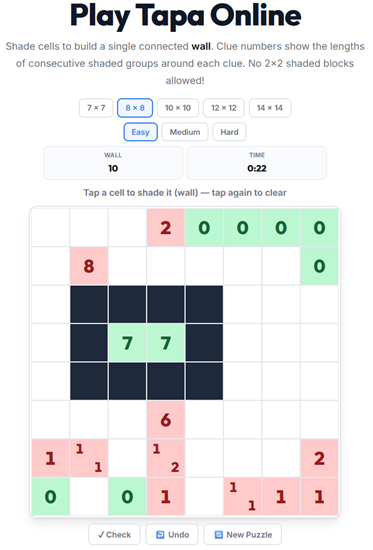
Tapa
Create a single connected wall of shaded cells. Clue cells (which are never shaded) contain a set of numbers describing the lengths of consecutive shaded segments in the eight cells surrounding the clue, reading clockwise. The wall can never form a 2×2 block. Tapa is a modern classic driven entirely by its numeric clues.
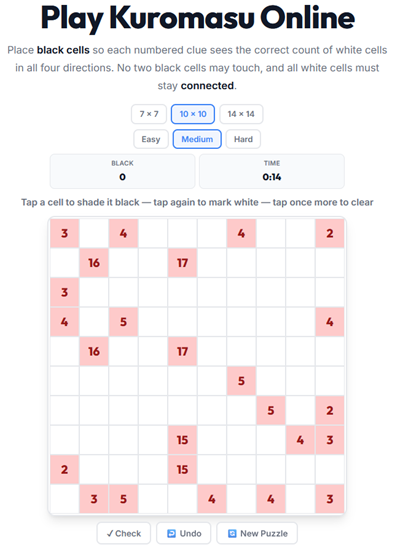
Kuromasu (Where is Black Cells?)
Numbers in the grid indicate how many white cells are visible from that cell in all four orthogonal directions (counting itself). Shade the remaining cells black so no two black cells are adjacent and all white cells stay connected. Kuromasu is a clean, elegant number puzzle that rewards careful counting.
Thermometers
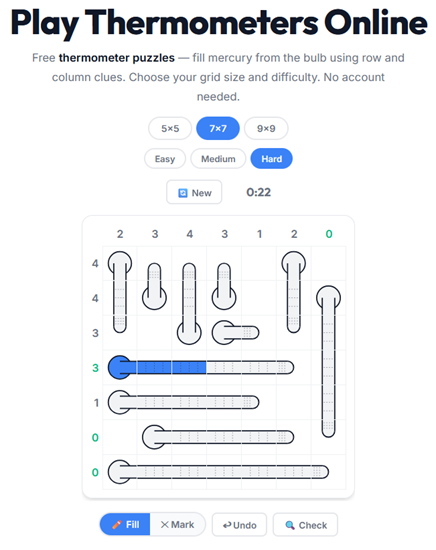
The grid contains thermometer shapes. “Fill” each thermometer from the bulb end upward (you can partially fill it, but can't skip cells). Row and column numbers tell you the total count of filled cells in each line. Thermometers is beautifully intuitive — the constraint that liquid fills from the bottom makes the logic visual and approachable.
Nonograms (Picross / Griddlers)
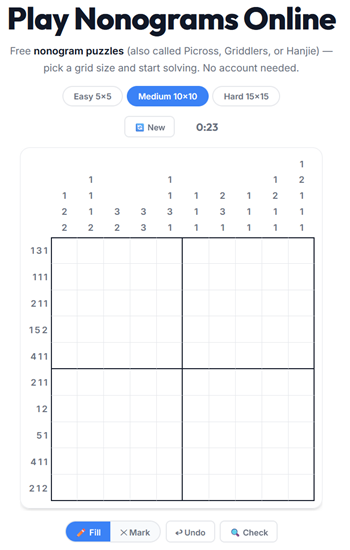
Each row and column has a sequence of numbers describing consecutive runs of shaded cells. Work through the number clues logically, and a pixel-art picture gradually emerges from the grid. Nonograms are arguably the most visual number puzzle — the numbers drive everything, and the reward is a picture you've decoded. Also known as Picross, Griddlers, Hanjie, or Paint by Numbers.
Nurikabe
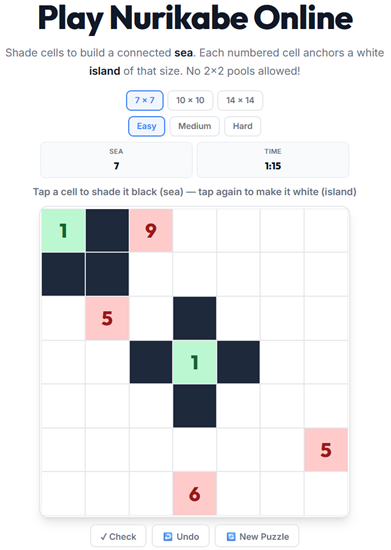
Numbered cells are “islands”; each number tells you how many white cells that island spans. Shade the remaining cells to form a single connected “sea.” Islands can't touch orthogonally, and the sea can never form a 2×2 block. Nurikabe is one of Nikoli's most beloved number-driven puzzles.
Shikaku (Rectangles)
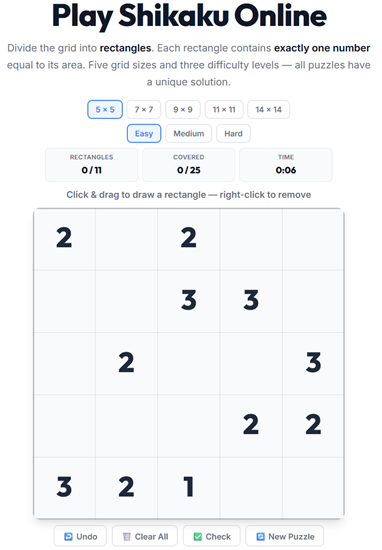
Divide the grid into non-overlapping rectangles. Each rectangle contains exactly one number, and that number equals the rectangle's area. Shikaku is wonderfully spatial — the numbers tell you the size; you figure out the shape and placement. A great puzzle for people who like tangram-style spatial reasoning.
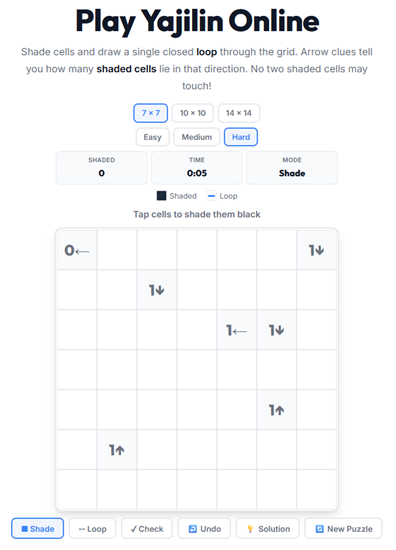
Yajilin (Arrow Puzzle)
Draw a single closed loop on the grid. Some cells contain an arrow and a number — the number tells you how many shaded cells lie in the arrow's direction. Shaded cells sit outside the loop and can never be adjacent. It's the numbers and their arrows that drive every deduction.
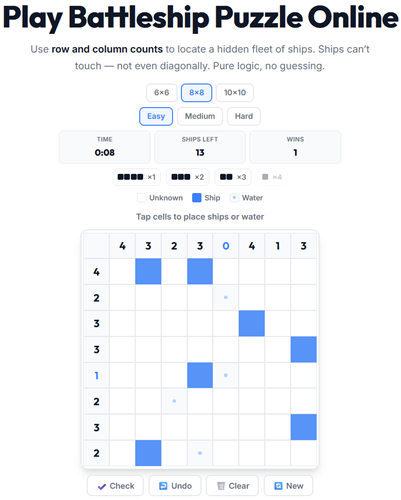
Battleship Puzzle (Solitaire)
The pencil puzzle version of the classic board game. A hidden fleet of ships sits on the grid (ships can't touch, even diagonally). Row and column numbers tell you how many ship segments appear in each line, and a few segments are revealed as starting hints. Deducing ship placements from the numbers alone is surprisingly deep.
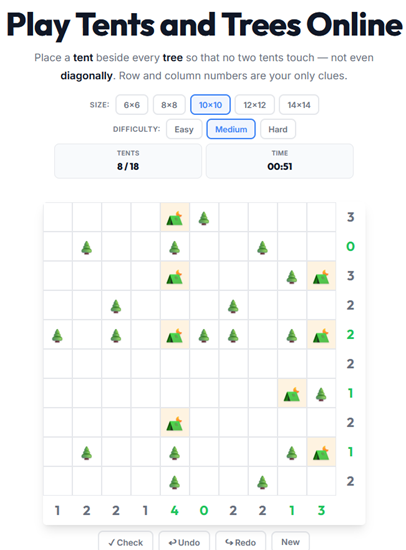
Tents and Trees
Every tree needs a tent placed orthogonally adjacent to it. Tents can never touch each other, not even diagonally. Row and column numbers tell you the total count of tents in each line. The numbers are the engine of every deduction — you cross-reference them with tree positions to pinpoint tent locations.
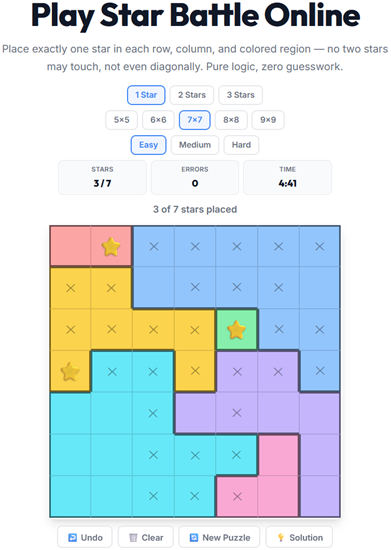
Star Battle
Place stars on the grid so that every row, every column, and every outlined region contains exactly the same number of stars (usually one or two). Stars can never touch each other, not even diagonally. The “number of stars per unit” drives the difficulty and solving strategy.
Mosaic (Fill-a-Pix)
Each clue number tells you how many cells in its 3×3 neighborhood (including itself) are shaded. If that sounds like Minesweeper on paper, you're exactly right. Mosaic is sometimes called “Fill-a-Pix” and is a great stepping stone for anyone who loves Minesweeper-style number logic.
Tent (Row/Column Counting)
A broad family of puzzles where row and column totals guide placement. Many puzzle types (Battleship, Tents and Trees, Thermometers) share this core mechanic. The satisfying “aha” moment comes when the numbers in two directions combine to pinpoint the only possible cell.
4. Elimination & Deduction Number Puzzles
These puzzles flip the script: instead of filling in digits, you're removing, shading, or deducing them through process of elimination. Numbers are on the grid from the start, and your job is to figure out which stay and which go — or what secret number you're looking for.
Hitori
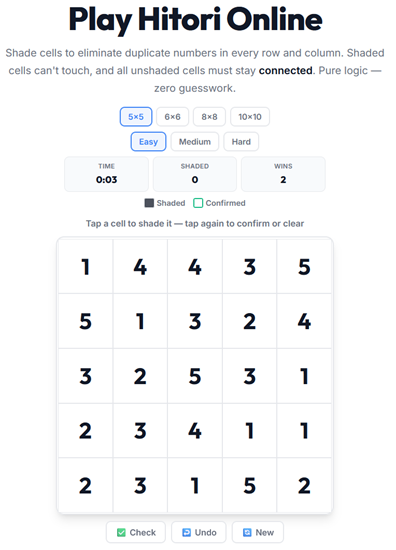
The grid starts completely filled with numbers. Your job is to shade out duplicate numbers so that no digit appears more than once in any row or column. Shaded cells can never be orthogonally adjacent, and all unshaded cells must remain connected. Instead of filling in, you're eliminating — a refreshingly different take on number puzzles.
Bulls & Cows (Mastermind)
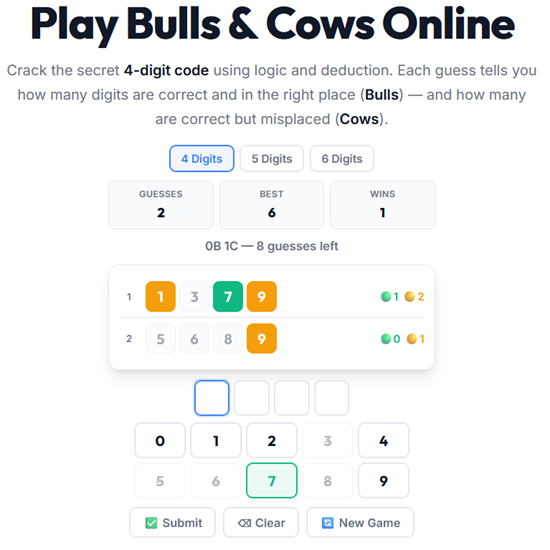
The original number-guessing deduction game. One player thinks of a secret number (typically 4 digits, all different); the other makes guesses and receives feedback: Bulls (correct digit in the correct position) and Cows (correct digit in the wrong position). Through logical elimination, you zero in on the secret number. Bulls & Cows is the direct ancestor of the board game Mastermind and a timeless number puzzle.
Ripple Effect (Hakyuu)
The grid is partitioned into rooms. Fill each room with digits 1–n (where n is the room's size). If two identical digits appear in the same row or column, they must be at least that digit apart. For example, two 3s need at least three cells between them. This spacing rule makes Ripple Effect unlike anything else in the number puzzle world.
Numberlink (Arukone)
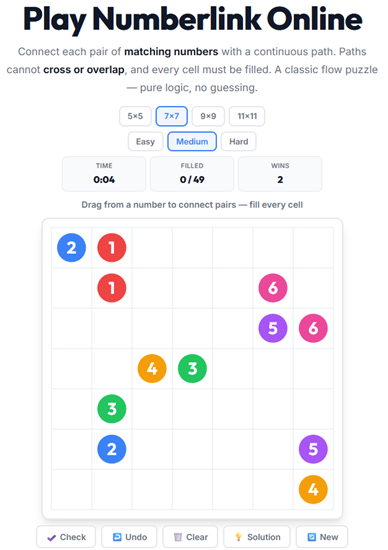
Pair up matching numbers by drawing non-crossing paths between them. In well-made Numberlink puzzles, the paths fill every cell of the grid. There's no arithmetic involved — the numbers simply identify which endpoints belong together — but the spatial deduction required is absorbing.
Masyu
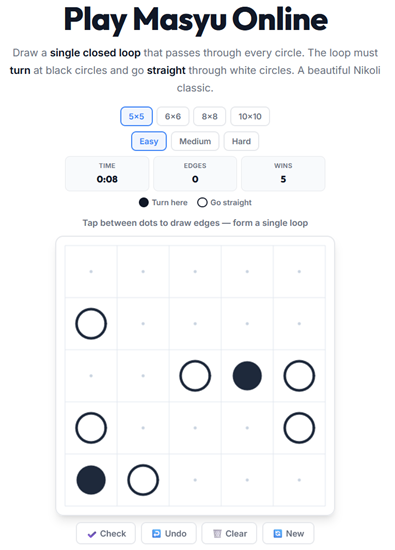
While Masyu uses circles rather than digits, it's often grouped with number puzzles because of its close kinship with Slitherlink and Numberlink. Draw a closed loop through every circle: at white circles the loop goes straight but must turn nearby, at black circles the loop turns but must go straight on either side. A beautiful counterpart to number-clue loop puzzles.
5. Action & Sliding Number Puzzles
Not every number puzzle is a slow, contemplative grid. Some are dynamic — you slide tiles, merge values, or race against the clock. These puzzles put numbers front and center but add a kinetic, strategic layer.
2048
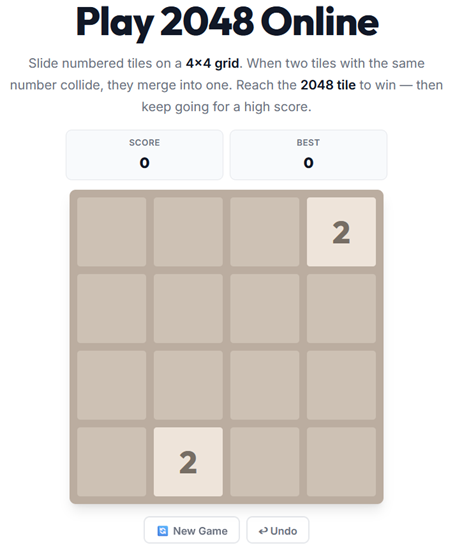
Slide numbered tiles on a 4×4 grid. When two tiles with the same number collide, they merge into one tile with double the value. The goal: keep merging until you create the 2048 tile (or go even higher). After every move a new tile spawns, so board management is critical. 2048 went viral in 2014 and remains one of the most-played number games in history. It rewards pattern recognition, forward planning, and the discipline to keep your highest tile in a corner.
15 Puzzle (Sliding Tiles)
One of the oldest mechanical number puzzles. Fifteen numbered tiles sit in a 4×4 frame with one empty space. Slide tiles into the gap to arrange them in numerical order. The 15 Puzzle was a worldwide craze in the 1880s and remains a benchmark for combinatorial puzzling. Digital versions often extend to 3×3 (8 Puzzle) or 5×5 (24 Puzzle) grids.
Threes
The game that inspired 2048. Slide tiles on a grid, but with a twist: 1s and 2s combine to make 3, and from there only matching numbers merge (3+3=6, 6+6=12, etc.). Threes has tighter, more strategic gameplay than 2048, with charming character tiles and a scoring system that rewards long-term planning.
Shift Three
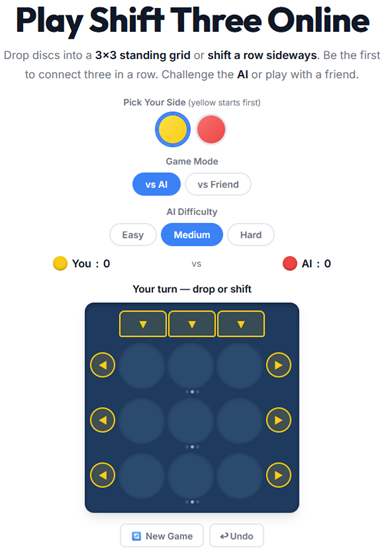
A unique take on the number-sliding genre. Tiles occupy a grid and you shift entire rows or columns to align matching numbers. The sliding mechanic creates a distinctive strategic feel — you're thinking not just about pairs but about how a single move ripples across the whole board.
Make 10 / Number Bonds
A family of quick number puzzles where you select groups of digits that sum to 10 (or another target). Tiles disappear when you hit the target, and new ones fall in. Make 10 puzzles are popular as math-training games and mobile time-killers, blending arithmetic fluency with pattern-spotting speed.
Drop Number (Suika-style)
Inspired by the viral “Suika Game” (Watermelon Game), drop-number puzzles have you dropping numbered balls into a container. When two balls of the same number touch, they merge into the next number up. The physics-based merging creates emergent strategy: placement and timing matter as much as the numbers themselves. A fresh twist on the merge genre.
Ready to Start Solving?
Whether you're a lifelong Sudoku fan or you've just discovered Kakuro, there's a number puzzle on this list for you. The genre's range is enormous: from five-minute Binary grids to hour-long Killer Sudoku marathons, from the meditative logic of Fillomino to the frantic merging of 2048.
We offer free playable versions of over 20 of the number puzzle types listed above — all running right in your browser with no download or account needed. Pick a puzzle, click the play button, and see how far your number skills can take you.
Explore All Our Free Online Number Puzzles
We have over 20 number puzzles available to play for free, right in your browser. No sign-up, no downloads — just pick a puzzle and start solving.
Browse All Puzzles