Play Super Tic-Tac-Toe Online
Nine tic-tac-toe boards, one epic strategy game. Your move decides where your opponent plays next. Win three small boards in a row to claim victory. Three AI levels or play a friend.
Created by Brian Hamilton
X to play — click any cell
How to play Super Tic-Tac-Toe
Nine small boards in a 3×3 grid. Win three small boards in a line to win the game.
- Win a small board by getting three in a row inside it. That claims its square on the big grid.
- The cell you play decides where your opponent must play. Take the top-right cell of any board and they must play in the top-right board.
- If the board they are sent to is already finished — won or drawn — they may play anywhere instead. That free move is the biggest thing you can give away.
- A small board that fills up without a line is drawn: nobody claims it, and nobody may play there again.
- Three claimed squares in a line wins. If every board resolves without that happening, the game is drawn.
Controls: tap any highlighted cell — only legal cells respond. Undo takes back the last move. Choose your opponent — three AI levels or a second player — above the board.
Your move chooses their board
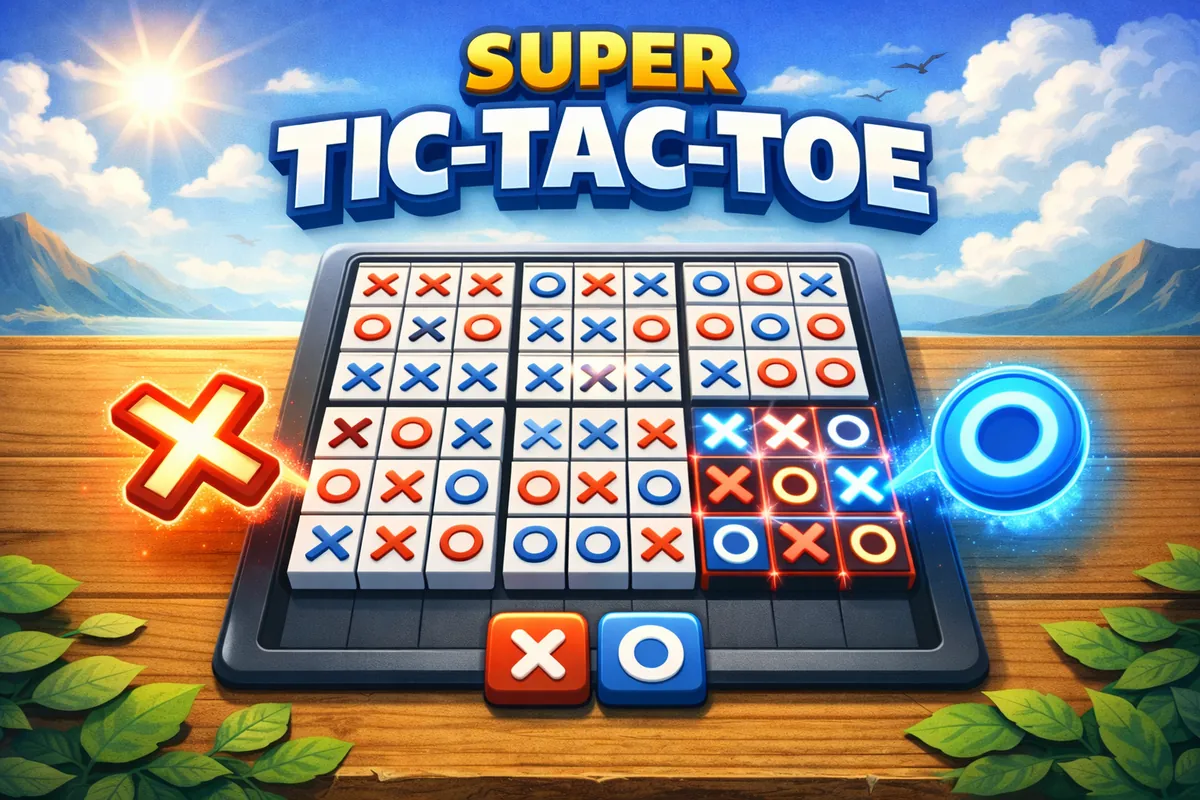
Nine small games of noughts and crosses, arranged in a 3×3 grid. Win a small board and you claim its square on the big one; claim three big squares in a line and you win. That much is just tic-tac-toe twice over. The rule that makes it a real game is where you are allowed to play.
The cell you play decides the board they play in. Take the top-right cell of any small board and your opponent must play in the top-right board. Take the middle cell and they go to the middle board. They have no choice at all.
So every move is really two decisions, and the second one usually matters more. A move that gains you nothing locally can be excellent because of where it sends the other player, and a move that wins a small board can be a disaster for the same reason.
The free move is the thing to protect
There is one exception to the send. If the board you would send them to is already finished — won by either player, or full and drawn — then they may play anywhere.
A free move is the largest single concession in the game. Instead of being confined to nine cells, your opponent picks from the whole grid: they can take the board they most want, set up a threat where you cannot answer, and choose where to send you next.
This is measurable, and it separates the difficulty settings on this page more cleanly than anything else. Given a position where the free move could have been avoided, the Hard opponent hands one over in 5% of cases. Easy does it in 27% — it plays at random, so it simply does not know.
The habit worth building: before you commit, look at the cell you are about to take and picture the board with that number. Would you be happy to play there? If not, look for a different cell that does a similar job.
Winning a board is not automatically good
Beginners take every small board they can, because in ordinary tic-tac-toe that is simply the game. Here it is a trade, and often a bad one.
Two things make small boards worth less than they look. A board you win is closed, so from then on anybody sent there gets a free move — you have created a permanent gift in that square of the grid. And winning it means playing a particular cell, which sends your opponent somewhere specific, and they get to use that.
The boards genuinely worth having are the ones that do work on the big board: the centre, which sits on four of the eight winning lines, and the corners, which sit on three each. An edge board sits on only two. Winning an edge board that hands over a free move is usually a losing trade.
Where games are actually decided
Play for the big board, not the small ones. Ask what three squares you are trying to claim before you fight over any of them. A small board you have no use for is a small board worth losing.
Chains beat threats. The strongest sequences send your opponent somewhere harmless, take the reply they are forced into, and send them somewhere harmless again. A player who can keep the other side pinned in boards they do not want is winning even without a single completed line.
Watch for the return trip. Playing cell 4 of board 4 sends them to board 4 — where you have just moved. Cells that point back at the board you are in are worth knowing, because they keep the fight local and predictable.
A drawn board is not a wasted board. It closes the square for both of you, and it removes one of the eight lines from your opponent's plans as surely as from your own. When you are behind on the big board, steering a square towards a draw is a real defensive resource.
What was verified on this page
Winning a small board was compared with an independent implementation on 20,000 random boards, and the meta-board result on 20,000 more — including the case that trips people up, where three drawn squares in a line win the game for nobody. Legal moves matched the rules on 4,000 positions, across both the forced case and the free one. All 2,000 test games reached a proper result.
The send rule was checked exhaustively rather than by sampling: for all 81 combinations of board and cell, playing cell c sends the opponent to board c. Being sent to a board that is already won frees them, and so — the case implementations forget — does being sent to one that is full but drawn.
Two defects were found in the AI, and both are fixed. The first was that the Hard opponent declined to win. Its search scored a win found several moves ahead as slightly better than a win available immediately, because the two were measured on different scales — so given a move that ended the game on the spot, it took it only 20 times out of 40. It now takes all 40.
The same fix made it faster. Each candidate move was being searched from scratch with no information carried over from the previous one, which threw away most of the pruning a search of this kind depends on. Correcting that cut the median move from 235ms to 90ms, and the worst case from 1,532ms to 930ms — comfortably inside the point where a pause becomes visible.
The second defect was the same blunder one setting down: Medium scored a move that won a small board identically whether or not that also won the game, so the centre bonus and the send heuristics could talk it out of finishing. It took 22 of 40 available wins; it now takes all 40. Declining to win a won game is a bug, not a difficulty level.
| Setting | Takes an immediate win | Gives away a free move |
|---|---|---|
| Easy | 9 / 40 | 27% |
| Medium | 40 / 40 | 23% |
| Hard | 40 / 40 | 5% |
Easy is meant to play at random and does, which is what makes it a reasonable first opponent. The difference between Medium and Hard is almost entirely the send: they take immediate wins equally well, but only Hard consistently avoids giving the free move away.
An old idea that took off late
Super Tic-Tac-Toe — also called Ultimate Tic-Tac-Toe, and sometimes nested or meta tic-tac-toe — has no single agreed inventor and circulated for years as a pen-and-paper curiosity before spreading widely online around 2013.
Its appeal is the amount of game squeezed out of one added rule. Ordinary tic-tac-toe is solved, trivial and drawn between competent players. Constrain where the next move may go, and the same 3×3 grid produces a game with genuine long-range planning — without adding a single new piece, board size or victory condition.
More Strategy Games
Enjoy Super Tic-Tac-Toe? Try these other free games: