Pencil Puzzles Online — The Complete Guide to Free Pencil Puzzles
Pencil puzzles — the kind you solve with logic, a grid, and (traditionally) a pencil — are one of the most satisfying forms of brain exercise ever invented. Whether you grew up filling in Sudoku grids on the train or you've never heard of Slitherlink, this guide covers every pencil puzzle type worth knowing about.
Better yet, many of these puzzles are now available to play free online. No downloads, no sign-ups — just open your browser and start solving. Below you'll find over 40 pencil puzzle types organized by category, each with a short explanation of how it works. Wherever we offer a free browser version, there's a direct link so you can jump straight in.
What Are Pencil Puzzles?
A pencil puzzle (sometimes called a logic puzzle or grid puzzle) is a puzzle printed on paper that you solve using pure deductive reasoning. The most famous example is Sudoku, but the genre is enormous — Japanese puzzle publisher Nikoli alone has invented or popularized dozens of types since the 1980s.
What all pencil puzzles share:
- A grid — usually square, occasionally rectangular or irregular.
- A set of rules — simple constraints that a valid solution must satisfy.
- A unique solution — every well-made pencil puzzle can be solved through logic alone, with exactly one answer.
- No guessing required — trial and error is never necessary if the puzzle is properly constructed.
The digital versions work exactly the same way — you're just clicking cells instead of shading them with a pencil. The logic is identical, and the satisfaction of cracking a tough puzzle is just as real.
Puzzle Categories
We've organized the puzzles into five broad families. Click a category to jump straight to it:
- Number Placement Puzzles — fill grids with digits following arithmetic or uniqueness rules
- Shading & Painting Puzzles — decide which cells to shade black or leave white
- Loop & Path Puzzles — draw a continuous loop or connect paths through the grid
- Object Placement & Deduction Puzzles — position objects or determine cell states
- Region & Connection Puzzles — divide the grid into regions or build connections
1. Number Placement Puzzles
These are the pencil puzzles most people think of first. You're given a grid — sometimes with a few numbers already filled in — and your job is to complete it so every digit obeys the stated rules. No arithmetic wizardry required; it's all about logical elimination.
Sudoku
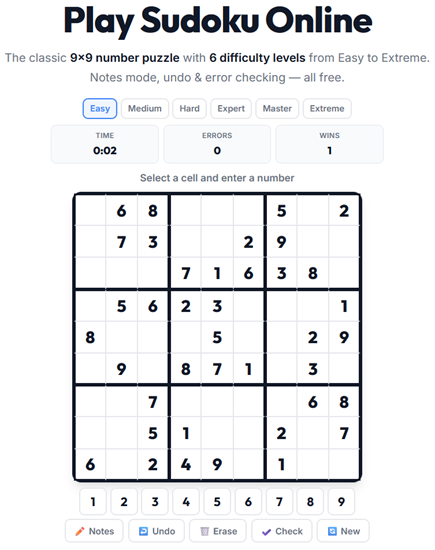
The undisputed king of pencil puzzles. Fill a 9×9 grid so that every row, every column, and every 3×3 box contains the digits 1–9 exactly once. Sudoku exploded into the mainstream in the mid-2000s and remains the world's most popular logic puzzle. Difficulty ranges from gentle warm-ups to diabolical grids that require advanced techniques like X-Wing and Swordfish.
Kakuro
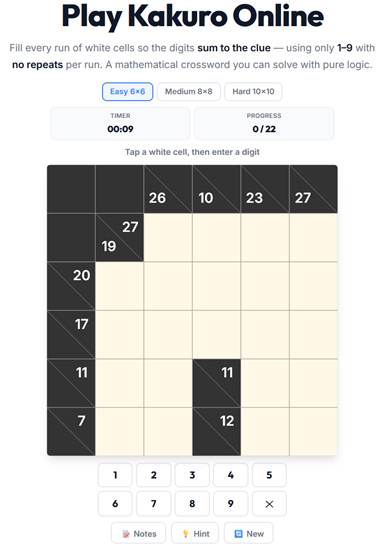
Often called a cross-sum or number crossword, Kakuro uses a crossword-style grid where each "run" of white cells must add up to the clue shown at its start. Digits 1–9 can each appear only once per run. It blends the satisfaction of Sudoku with light arithmetic, and it's a staple of every serious pencil puzzle magazine.
KenKen
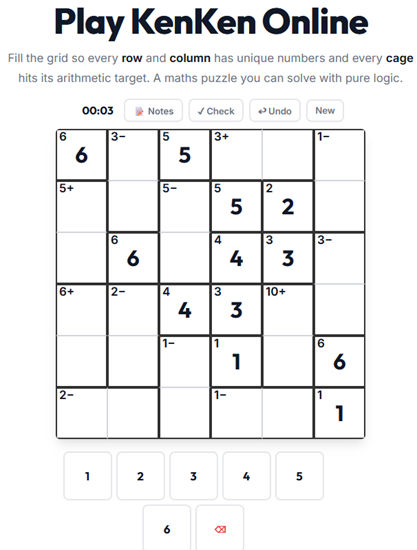
Invented by Japanese math teacher Tetsuya Miyamoto, KenKen (also marketed as KenDoku or Mathdoku) asks you to fill an n×n grid with 1–n so that no digit repeats in any row or column. Groups of cells (“cages”) are marked with a target number and an operation (+, −, ×, ÷) that the digits inside must satisfy. It's a brilliant crossover of Sudoku-style logic and basic arithmetic.
Futoshiki
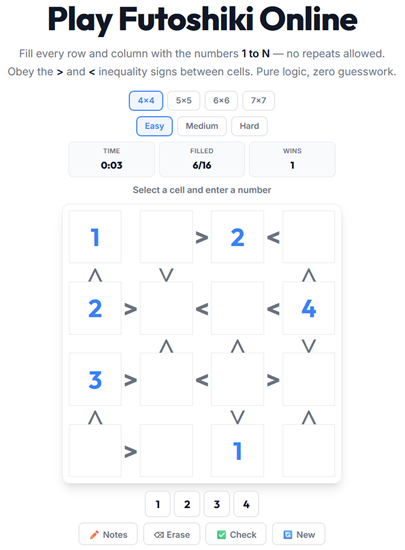
Fill an n×n grid with digits 1–n so that no number repeats in any row or column — just like a Latin square. The twist: inequality signs (< and >) between certain cells add extra constraints. Futoshiki is a great entry point into pencil puzzles because the rules are dead simple, but harder grids offer genuine challenge.
Skyscrapers
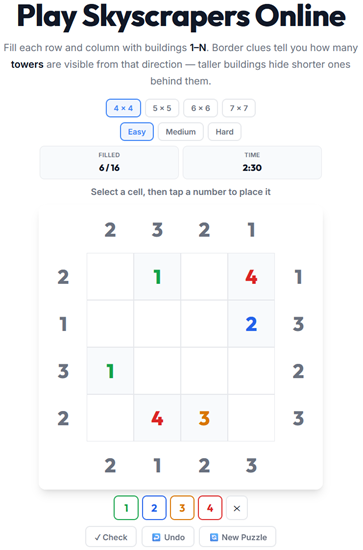
Imagine looking at a city skyline from the edge of a grid. Each cell contains a “building” of height 1–n, with no height repeated in any row or column. Clues around the border tell you how many buildings are visible from that direction — taller buildings block shorter ones behind them. It's spatial reasoning wrapped in a clean logic framework.
Suguru (Tectonics / Number Blocks)
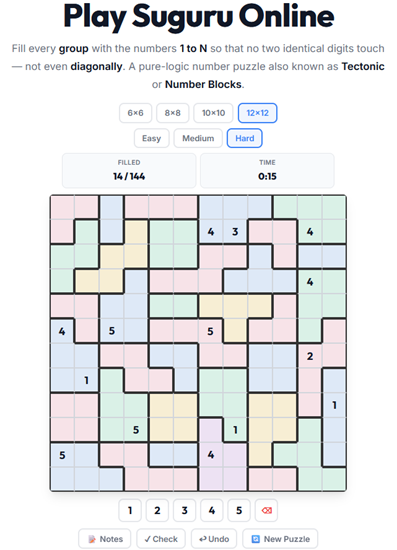
The grid is divided into irregular regions of varying sizes. Fill each region with the digits 1 through n, where n is the number of cells in that region. The catch: no two identical digits can be adjacent — not even diagonally. Suguru puzzles are compact, quick to solve at easy levels, and deceptively tricky at harder ones.
Fillomino (Polyominous)
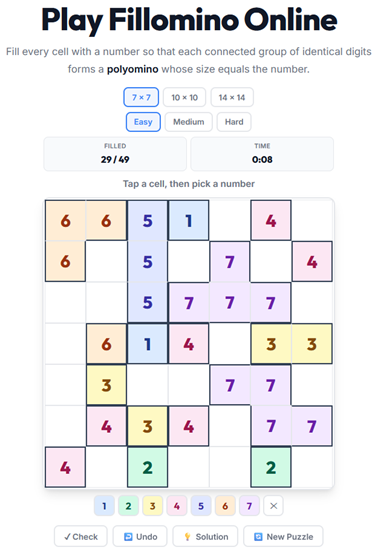
Fill every cell with a number so that each group of connected cells sharing the same number forms a polyomino (a contiguous block) whose size equals that number. For example, a group of 4s must cover exactly four connected cells. Clue numbers are given; the rest you deduce. Unlike most number puzzles, Fillomino doesn't have fixed regions — you discover them as you solve.
Hitori
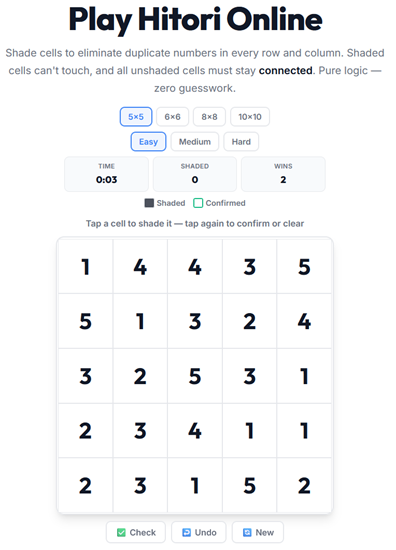
Hitori starts with a grid entirely filled with numbers. Your job is to shade out duplicate numbers so that no digit appears more than once in any row or column. Shaded cells can never be orthogonally adjacent, and all unshaded cells must remain connected as one group. It flips the usual pencil puzzle formula on its head — instead of filling in, you're eliminating.
Killer Sudoku
A hybrid of Sudoku and Kakuro. The standard Sudoku rules apply (1–9 in every row, column, and box), but instead of given digits you get dashed cages with sum totals. Digits within a cage must add up to its total and cannot repeat. Killer Sudoku has a devoted following and regularly appears in the World Puzzle Championship.
Calcudoku
Very similar to KenKen, but with a key difference: digits can repeat within a cage (as long as they don't repeat in a row or column). This subtle change opens up harder deductions and makes Calcudoku a favorite in competitive puzzle circles. Sometimes published under the name “Calkuro.”
Hidato (Number Snake)
Fill a grid with consecutive integers starting from 1 so that each number is orthogonally or diagonally adjacent to the next. A few numbers are given as anchors. The result is a continuous path that snakes through every cell. Hidato is approachable and satisfying — it's essentially a logic-driven connect-the-dots for adults.
Ripple Effect (Hakyuu)
The grid is partitioned into rooms. Fill each room with digits 1–n (where n is the room's size). If two identical digits appear in the same row or column, they must be at least that digit apart. For example, two 3s in the same row need at least three cells between them. This spacing rule makes Ripple Effect unlike anything else in the genre.
2. Shading & Painting Puzzles
In shading puzzles you decide, for each cell, whether it's filled (shaded / black) or empty (white). Clue numbers and connectivity rules guide your decisions. These puzzles are especially satisfying in digital form because you can toggle cells on and off instantly.
Nonograms (Picross / Griddlers)
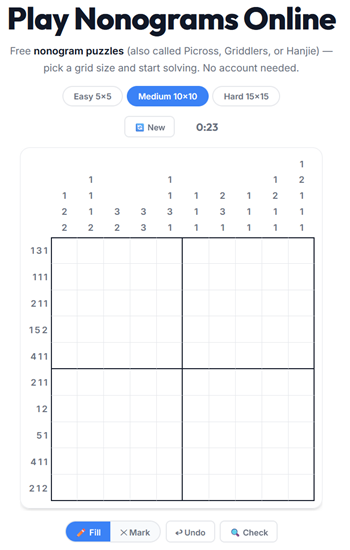
Arguably the second most famous pencil puzzle after Sudoku. Each row and column has a sequence of clue numbers that describe consecutive runs of shaded cells. Work through the clues logically, and a pixel-art picture gradually emerges from the grid. Nonograms range from small 5×5 warm-ups to epic 40×30 grids that reveal detailed images. Also known as Picross, Griddlers, Hanjie, or Paint by Numbers.
Nurikabe
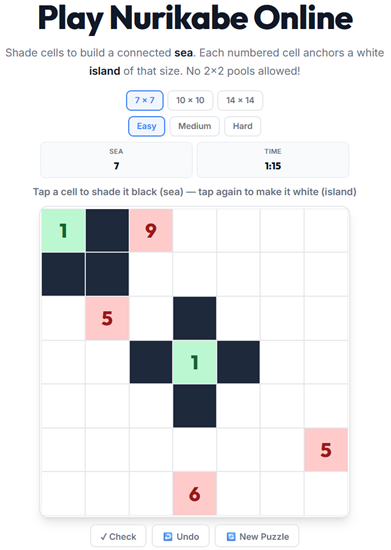
Numbered cells are “islands”; your job is to shade the remaining cells to form a single connected “sea.” Each island must contain exactly as many white cells as its number indicates, islands can't touch each other orthogonally, and the sea can never form a 2×2 block. Nurikabe is one of Nikoli's most elegant inventions — simple rules, deep logic.
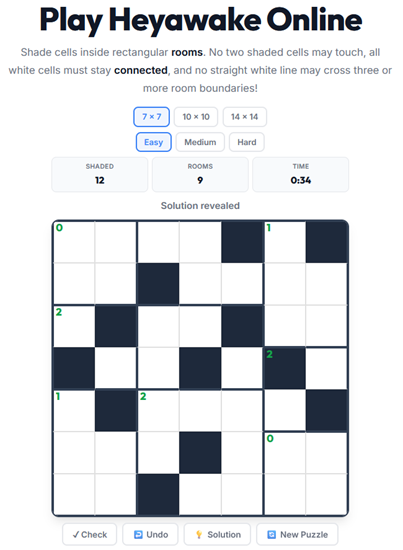
Heyawake
The grid is divided into rectangular rooms, some with numbers. Shade cells so that: no two shaded cells are adjacent, all unshaded cells form one connected group, no horizontal or vertical line of unshaded cells spans more than two rooms, and each numbered room contains exactly that many shaded cells. The room-spanning rule makes Heyawake uniquely tricky.
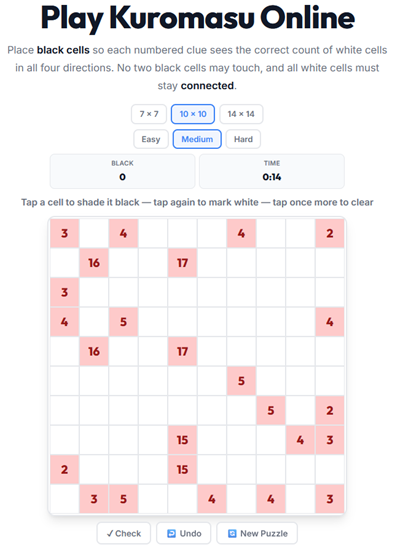
Kuromasu (Where is Black Cells?)
Some cells contain numbers that indicate how many white cells are visible from that cell, looking in all four orthogonal directions (the numbered cell counts itself). Shade the remaining cells black so that no two black cells are adjacent and all white cells stay connected. A clean, elegant puzzle that rewards careful counting.
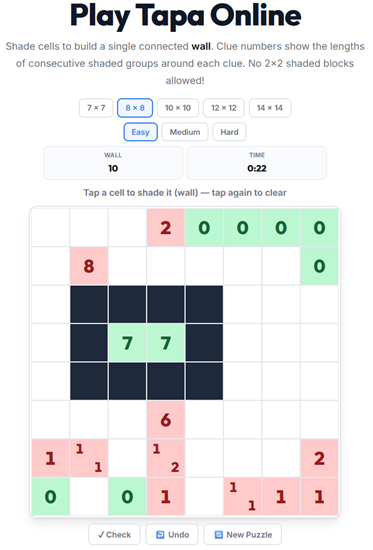
Tapa
Create a single connected wall of shaded cells. Clue cells (which are never shaded) show a set of numbers that describe the lengths of consecutive shaded segments in the eight cells surrounding the clue, reading clockwise. The wall can never form a 2×2 block. Tapa is a modern classic — relatively new, but already a fixture in puzzle competitions.
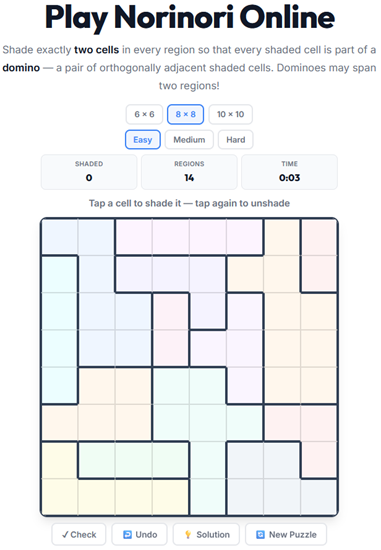
Norinori
Shade exactly two cells in every region. Every shaded cell must be part of a domino (a 1×2 or 2×1 pair of adjacent shaded cells), but a single domino can span two different regions. Norinori is fast and approachable at small sizes but scales up to brain-bending grids.
LITS (Nuruomino)
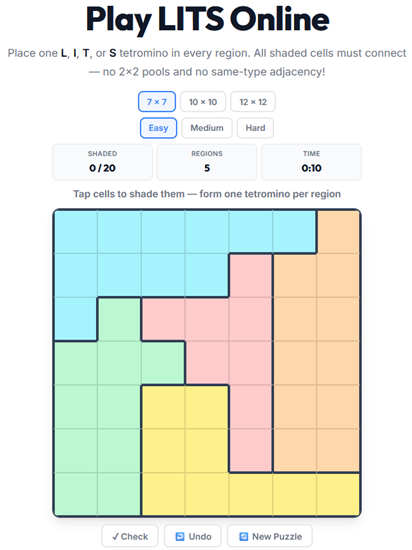
Place exactly one tetromino (an L, I, T, or S shape made of four cells) in each region. All tetrominoes must form a single connected group, but two tetrominoes of the same shape can never touch each other by a side. The shaded cells can never form a 2×2 square. It's one of the most satisfying region-based shading puzzles around.
Yin-Yang
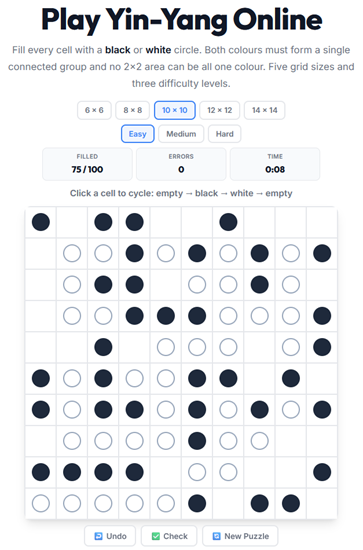
Color every cell either black or white. All black cells must form one orthogonally connected group, and all white cells must form another. No 2×2 square can be entirely one color. Some cells are pre-filled to get you started. The rules are beautifully minimal, but the puzzles can be surprisingly deep.
Cave (Corral / Bag)
Determine which cells are “inside” and “outside” a cave. Inside cells form a single connected region with no enclosed holes. Numbered cells are always inside and can see exactly that many inside cells in their row and column (including themselves). The edge of the grid naturally forms the boundary. Cave puzzles are elegant and highly visual.
Aquarium
The grid is divided into “tanks” (irregular regions). Fill cells with water, obeying gravity — within each tank, a filled cell means everything below it in the same tank is also filled. Row and column clues tell you the total number of filled cells in each line. Aquarium is intuitive, beginner-friendly, and oddly relaxing.
Mosaic
Each clue number tells you how many cells in its 3×3 neighborhood (including itself) are shaded. If that sounds like Minesweeper on paper, you're exactly right. Mosaic is sometimes called “Fill-a-Pix” and is a great stepping stone for anyone who loves Minesweeper logic.
Shakashaka
Place right triangles (in four possible orientations) into white cells so that every remaining white space forms a rectangle or square. Numbered black cells indicate how many of their orthogonal neighbors contain a triangle. Shakashaka is visually distinctive and exercises spatial reasoning in ways most pencil puzzles don't.
3. Loop & Path Puzzles
Here your pencil (or mouse) literally draws: you're constructing a single closed loop or connecting paths through the grid. Clue numbers constrain where the line can go, but figuring out the exact path requires careful deduction.
Slitherlink (Fences / Loop the Loop)
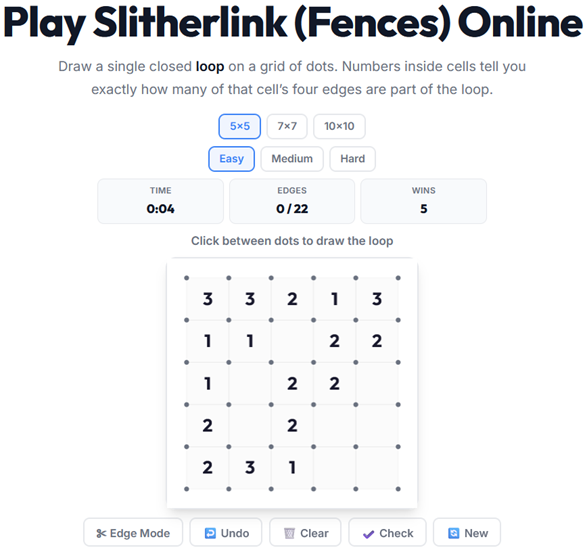
Draw a single non-crossing, non-branching loop along the edges of a square grid. Some cells contain a number (0–3) that tells you exactly how many of that cell's four edges are part of the loop. Slitherlink is one of Nikoli's greatest hits — the interaction between neighboring clues creates cascading deductions that feel incredibly satisfying to unravel.
Masyu
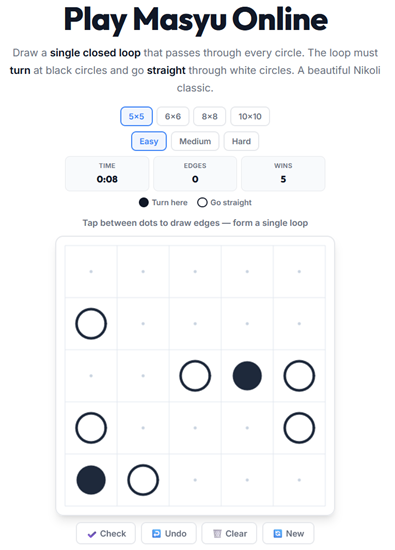
Draw a closed loop that passes through every circle on the grid. At a white circle, the loop must go straight through but must turn on at least one of the cells immediately before or after. At a black circle, the loop must turn 90° but must go straight through both cells immediately before and after the turn. The rules look fiddly on paper, but in practice the logic feels intuitive and flows beautifully.
Numberlink (Arukone)
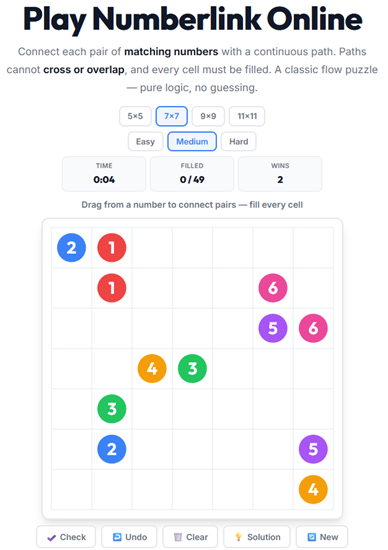
Pair up matching numbers by drawing non-crossing paths between them. In well-made Numberlink puzzles, the paths fill every cell of the grid. There's no arithmetic involved — it's pure spatial reasoning and a surprisingly addictive form of pencil puzzle.
Yajilin (Arrow Puzzle)
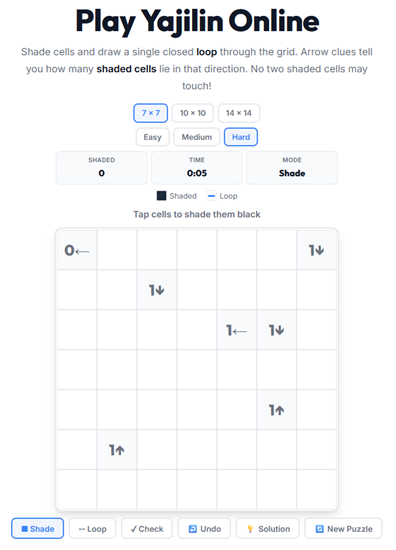
Draw a single closed loop on the grid. Some cells contain an arrow and a number — the number tells you how many shaded (black) cells lie in the arrow's direction. Shaded cells sit outside the loop and can never be adjacent. Yajilin cleverly combines loop-drawing logic with shading constraints.
Country Road
Draw a single closed loop that visits every region at least once. If a region contains a number, the loop must pass through exactly that many cells in that region. The loop can never pass through two consecutive cells that are both empty (loopless) and belong to different regions. Country Road is a satisfying blend of loop logic and regional reasoning.
4. Object Placement & Deduction Puzzles
Instead of numbers or shading, these puzzles ask you to place specific objects — stars, light bulbs, tents, mines, or other markers — according to given rules. Despite the variety of themes, the underlying logic is always the same: deduce where each object must (or can't) go.
Light Up (Akari)
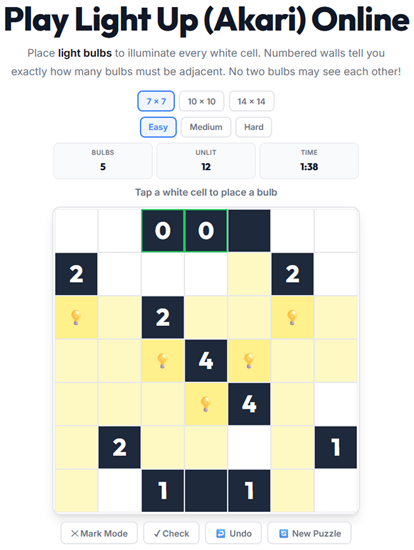
Place light bulbs on the grid to illuminate every white cell. A bulb lights its entire row and column until blocked by a black wall. No bulb can shine on another bulb. Numbered walls tell you exactly how many of their orthogonal neighbors are bulbs. Light Up is one of the most intuitive pencil puzzles — the “light beam” visual makes the logic easy to follow.
Star Battle
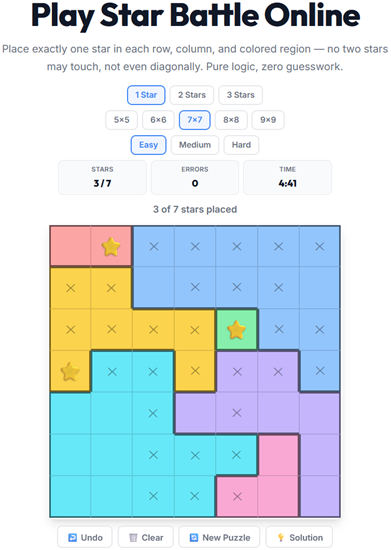
Place stars on the grid so that every row, every column, and every outlined region contains exactly the same number of stars (usually one or two). Stars can never touch each other, not even diagonally. Star Battle has surged in popularity thanks to its clean rules, elegant visuals, and surprisingly tough deductions.
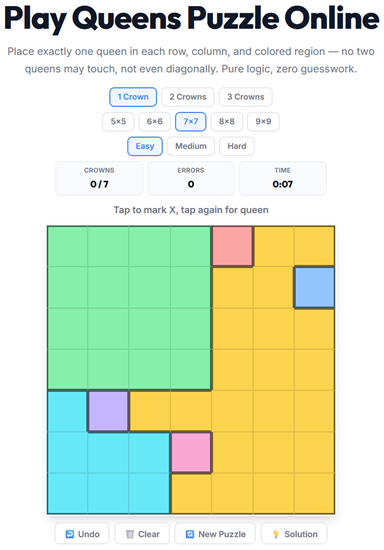
Queens
A colorful variant of the N-Queens problem. Place one queen on each colored region of the grid such that every row and every column also has exactly one queen — and no two queens touch each other, not even diagonally. If you enjoy Star Battle, Queens is a natural next step.
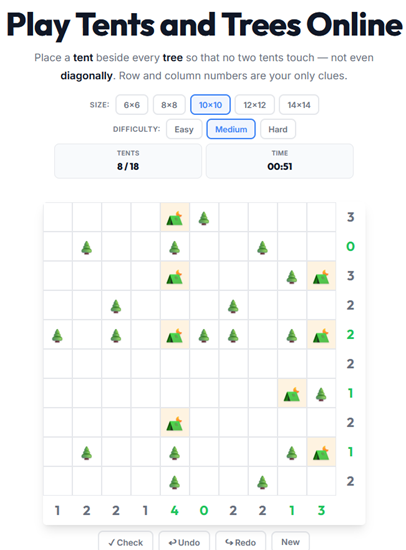
Tents and Trees
Every tree on the grid needs a tent placed orthogonally adjacent to it (each tent pairs with exactly one tree). Tents can never touch each other, not even diagonally. Row and column clues tell you the total number of tents in each line. It's a charming theme layered over rock-solid pencil puzzle logic.
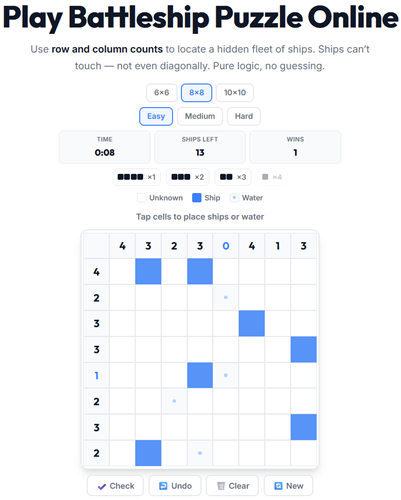
Battleship (Solitaire)
The single-player pencil puzzle version of the classic board game. A hidden fleet of ships is placed on the grid (ships can't touch, even diagonally). Row and column clues tell you how many ship segments appear in each line, and a few segments are revealed as starting hints. Battleship Solitaire has been a staple in puzzle magazines for decades.
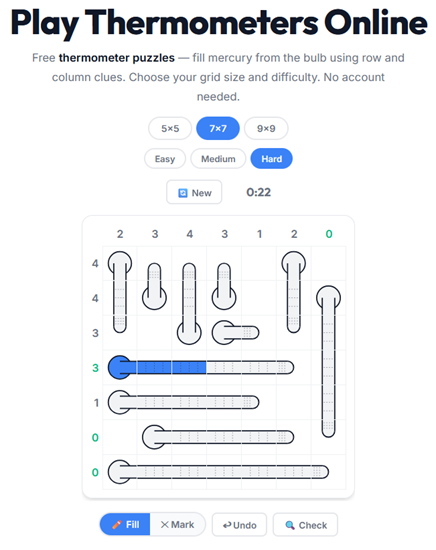
Thermometers
The grid contains thermometer shapes. “Fill” each thermometer from the bulb end upward (you can partially fill it, but you can't skip cells). Row and column clues tell you the total number of filled cells in each line. Thermometers is beautifully intuitive — the constraint that liquid fills from the bottom makes the logic visual and approachable.
Minesweeper (as a pencil puzzle)
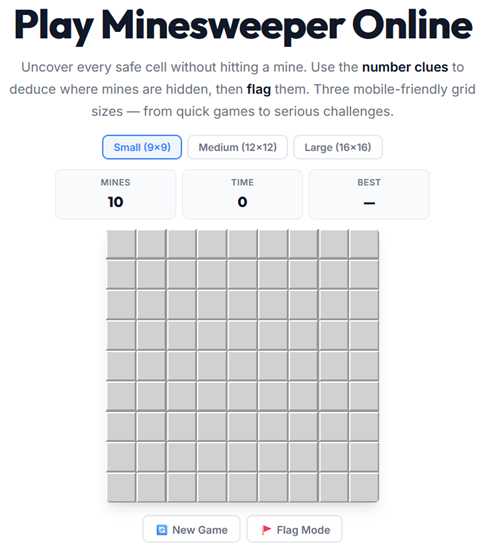
Yes, the classic computer game works perfectly as a pencil puzzle. Given a partially revealed grid where each number indicates how many mines sit in adjacent cells, determine the exact location of every mine using logic alone. In the pencil puzzle version there's no luck involved — every mine can be deduced.
Takuzu (Binary / Binairo)
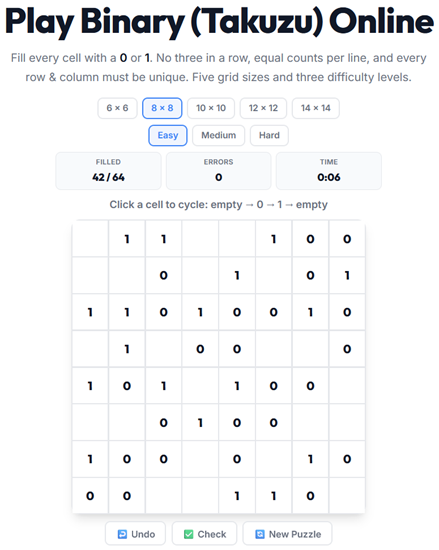
Fill a grid with 0s and 1s (or two colors). Each row and column must contain an equal number of each digit, no three consecutive cells in a line can be the same, and no two rows (or columns) can be identical. Takuzu is a perfect “palette cleanser” between heavier puzzles — fast, clean, and oddly addictive.
ABC End View (Easy as ABC)
Place the letters A, B, C (and sometimes more) in a grid so that each letter appears exactly once per row and column. Some cells remain blank. Clues around the border tell you which letter is the first one visible from that edge. It's a surprisingly elegant puzzle once you get the hang of the “line of sight” deduction.
Dominosa
A grid of numbers represents a full set of dominoes laid flat. Your job is to draw the boundaries so each domino tile appears exactly once. There's no arithmetic — it's pure pattern-matching and elimination. Dominosa is quick to learn and works brilliantly as a warm-up puzzle.
Kropki
Fill a Latin square grid with 1–n. Between some pairs of adjacent cells you'll see dots: a white dot means the two digits are consecutive, a black dot means one digit is double the other. If there's no dot, neither condition holds. Kropki is a favorite on the competitive circuit for its clean constraint-based reasoning.
5. Region & Connection Puzzles
These puzzles focus on dividing the grid into areas or building networks. You're drawing borders, connecting nodes, or partitioning space — always guided by numeric or spatial clues.
Shikaku (Rectangles)
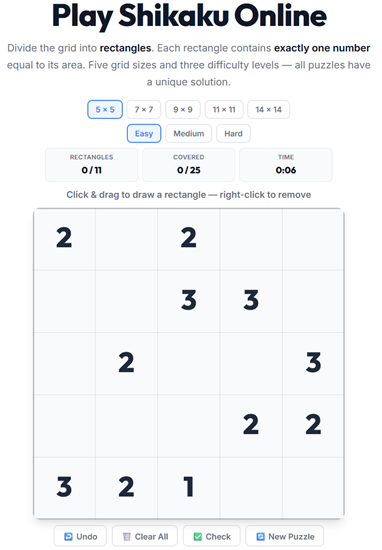
Divide the grid into non-overlapping rectangles (or squares). Each rectangle must contain exactly one number, and that number equals the rectangle's area. Shikaku is wonderfully spatial — you're essentially tiling a floor, and the logic of fitting pieces together is deeply satisfying.
Galaxies (Tentai Show)
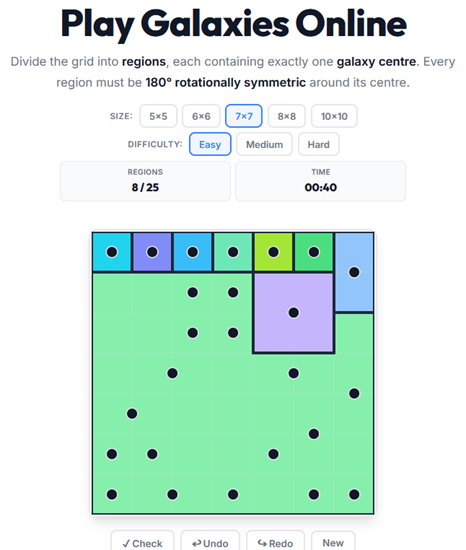
Divide the grid into regions, each containing exactly one circle (dot). Every region must be rotationally symmetric around its dot — if you spin it 180°, it looks the same. The shapes you discover are often surprising and beautiful. Galaxies is one of the most visually rewarding pencil puzzles.
Hashi (Hashiwokakero / Bridges)
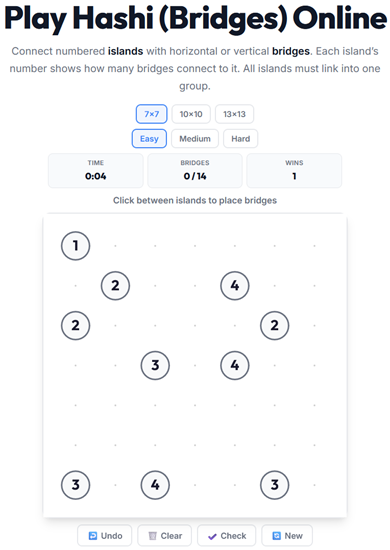
Numbered circles (“islands”) sit on the grid. Connect them with horizontal or vertical bridges (one or two between any pair). Each island's number equals its total bridge count. All islands must be connected into a single network, and bridges can't cross. Hashi is beautifully tactile and one of the best “gateway” pencil puzzles for beginners.
Tatamibari
Divide the grid into rectangles (or squares), each containing exactly one symbol. A + means the region is a square, a − means it's wider than tall, and a | means it's taller than wide. No four region corners may meet at a single point (the “tatami condition”). It's a niche puzzle, but fans of Shikaku or Galaxies will love it.
Stitches
Connect each pair of adjacent regions with exactly one stitch — a line segment between two orthogonally neighboring cells that lie in different regions. Row and column clues tell you the total number of stitch endpoints in each line. Stitches is a newer puzzle type that's quickly gaining fans on puzzle platforms.
Ready to Start Solving?
Whether you're brand new to pencil puzzles or you've been solving Sudoku for years, there's something on this list for you. The beauty of the genre is its range: from five-minute commute puzzles like Takuzu and Suguru, to multi-hour epics like large Nonograms or advanced Slitherlinks.
We offer free playable versions of over 30 of the puzzle types listed above — all running right in your browser with no download or account needed. Pick a puzzle from the list, click the play button, and see how far pure logic can take you.
Explore All Our Free Online Puzzles
We have over 30 pencil puzzles available to play for free, right in your browser. No sign-up, no downloads — just pick a puzzle and start solving.
Browse All Puzzles