Play Futoshiki Online
Fill every row and column with the numbers 1 to N — no repeats allowed. Obey the > and < inequality signs between cells. Pure logic, zero guesswork.
Created by Brian Hamilton
Select a cell and enter a number
How to play Futoshiki
Fill the grid so that every row and every column contains each number from 1 to the grid size exactly once.
- Signs between neighbouring cells must be obeyed: the wide end of > points at the smaller number.
- Signs only ever relate two cells that touch — they say nothing about cells further along the line.
- Cells with no sign between them are unconstrained apart from the no-repeats rule.
- Every puzzle has exactly one solution.
Controls: tap a cell and type or tap a number. Notes lets you pencil in candidates, which is how most of the middle game gets solved.
Chains are the only clues that pay immediately
A single inequality sign between two cells barely narrows anything. Chain three or four of them together, pointing the same way, and the line starts collapsing on its own.
The reason is that a row holds each of 1 to n exactly once. A rising chain of k cells needs k distinct increasing values, so the bottom of the chain cannot be large and the top cannot be small. The longer the chain, the tighter the squeeze from both ends.
| Chain length | Rows that fit | Bottom of the chain | Top of the chain |
|---|---|---|---|
| 2 | 60 | 1, 2, 3 or 4 | 2, 3, 4 or 5 |
| 3 | 20 | 1, 2 or 3 | 3, 4 or 5 |
| 4 | 5 | 1 or 2 | 4 or 5 |
| 5 | 1 | must be 1 | must be 5 |
A chain of two halves the possibilities and forces nothing. A chain of three cuts 120 rows to 20. A chain of four leaves five. And a chain spanning the whole row leaves exactly one arrangement — the row is simply 1, 2, 3, 4, 5 in order.
The rule to carry: in a rising chain of k cells, the top is at least k and the bottom is at most n − k + 1. Reverse it for falling chains. That single line of arithmetic does most of the early work in any Futoshiki.
A worked board
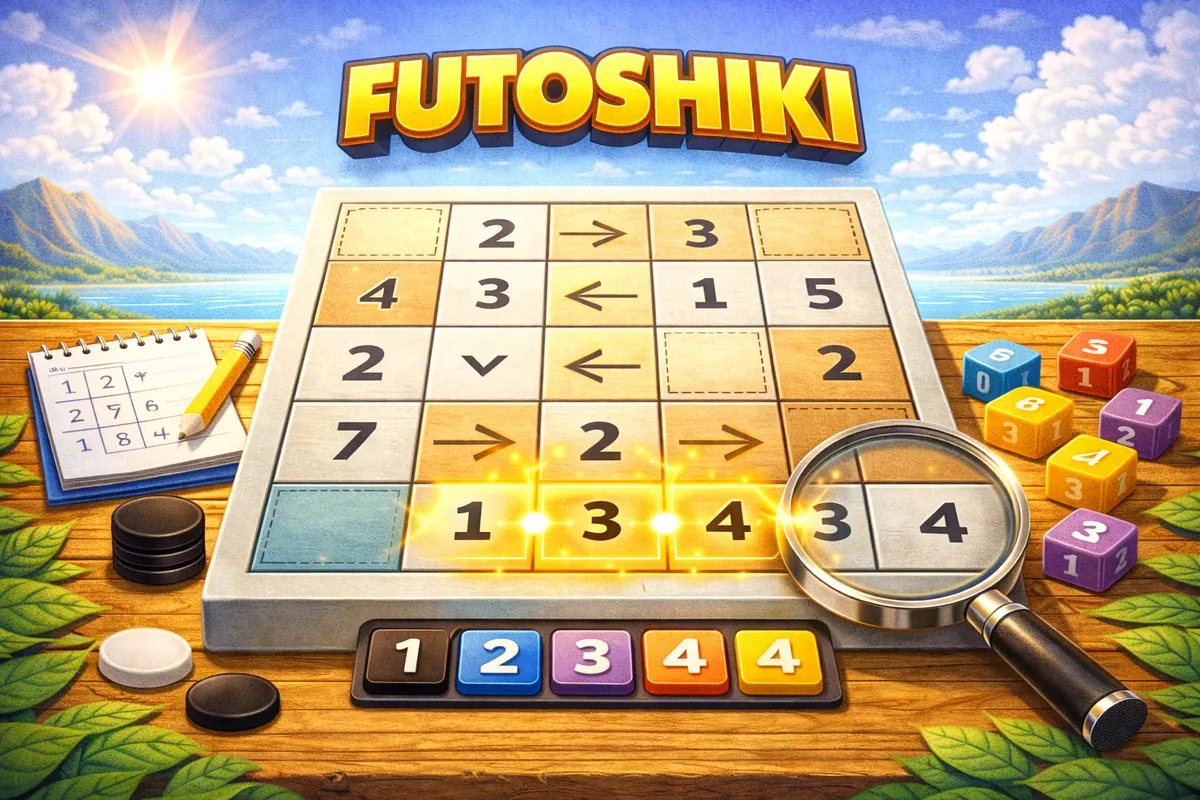
Here is a 5×5 from the generator on this page — a handful of given numbers and a scattering of signs.
The top row is where to begin. Its last three cells are linked by two less-than signs, so they rise from left to right.
Now add what is already on the board. The third cell of that row is a given 1, which is the smallest value available, and the fourth is a given 3. A rise from 1 to 3 leaves only the last cell to settle, and since it must exceed 3 and cannot repeat anything in the row, it is a 5.
On easy boards the signs are nearly decorative
It is worth knowing how the two kinds of clue divide the work, because it changes where you should look. Taking one generated board at each difficulty and stripping out one clue type at a time gives a stark answer.
| Difficulty | Givens | Signs | Solutions with no signs | Solutions with no givens |
|---|---|---|---|---|
| Easy | 10 | 25 | 1 | 3+ |
| Medium | 7 | 23 | 24+ | 5+ |
| Hard | 4 | 10 | 200+ | 200+ |
On the easy board the given numbers alone pin the grid down completely — delete every inequality sign and the puzzle still has exactly one answer. The signs are genuinely redundant there, which is why easy boards feel like a gentler Sudoku.
By hard, neither kind of clue survives on its own: remove either and the count runs past 200. The puzzle only works because the two constrain each other. That is the difficulty setting doing something real, not just taking numbers away.
Where solvers get stuck
Treating each sign in isolation. One sign between two cells rules out half the pairs and no more. Look for signs that link up into a run before spending time on them.
Forgetting the ends of the line. A cell at the end of a row with a “greater than” pointing away from it can never be a 1. These edge deductions are free and easy to miss because there is no sign on the outer side to draw the eye.
Ignoring the columns. The signs are visually horizontal and vertical, but the no-repeats rule works in both directions regardless. A value ruled out by a chain in a row is often the value a column has been waiting for.
Two things you can check about these puzzles
Every puzzle has exactly one solution, and it is verified by counting. Each board begins as a random Latin square. Inequality signs are derived from it, then given numbers are removed one at a time, each removal kept only if the puzzle still has a single answer. If the finished board cannot be confirmed unique, numbers are put back until it can.
Difficulty is the number of givens, and the signs thin out with them. On a 5×5 the generator aims for 10 givens on Easy, 7 on Medium and 4 on Hard, and the density of inequality signs drops from about three-quarters of the available gaps to under a third. Count the signs on an easy board and a hard one — the difference is visible at a glance.
Futoshiki, Unequal and Hutoshiki
Futoshiki (不等式) is Japanese for “inequality”, and the puzzle also appears as Unequal, Hutoshiki and More or Less. It is usually credited to the Japanese designer Tamaki Seto, and has run in British newspapers since the mid-2000s.
Underneath it is a Latin square, like Skyscrapers and Sudoku. What separates the three is the extra constraint: Sudoku adds boxes, Skyscrapers adds sightlines along a line, and Futoshiki adds a direct comparison between two touching cells.
More logic puzzles
If you like ordering constraints on a Latin square, try these: