Play Skyscrapers Online
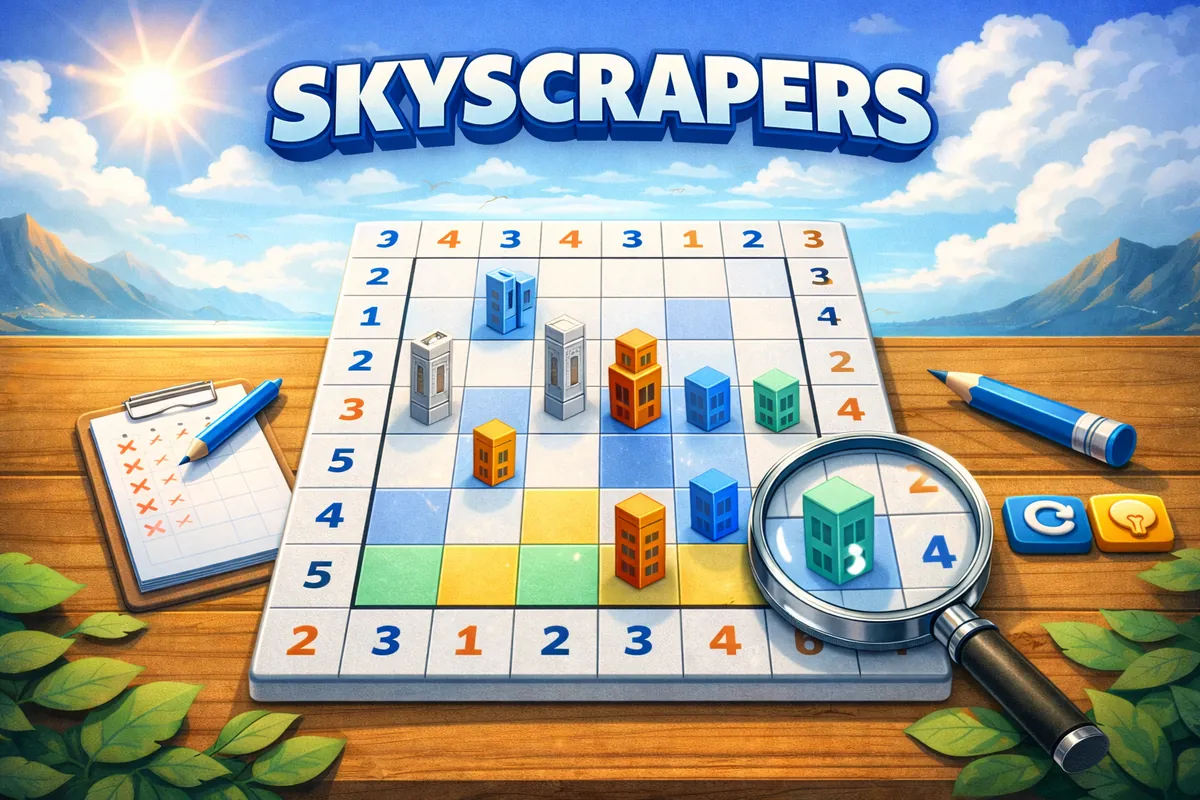
Fill each row and column with buildings 1–N. Border clues tell you how many towers are visible from that direction — taller buildings hide shorter ones behind them.
Created by Brian Hamilton
Select a cell, then tap a number to place it
How to play Skyscrapers
Fill the grid with building heights so that every row and every column contains each height from 1 to the grid size exactly once.
- The numbers around the edge say how many buildings are visible looking along that row or column from that side.
- A building is visible if every building in front of it is shorter. A taller building hides everything behind it.
- A blank on the border simply means no clue is given from that side.
- Every puzzle has exactly one solution.
Controls: tap a cell and type or tap a height. Notes lets you pencil in candidates. Grey starting numbers are given and cannot be changed.
The clue counts what you can see, not what is there
Every number around the edge of a Skyscrapers grid is a count of visible buildings, taken from that side. A building is visible if nothing taller stands in front of it. That is the whole rule, and getting it properly into your head is most of the battle.
Note what the clue is not. It is not a total, not a height, and not a position. Two rows containing exactly the same five numbers can carry completely different clues depending only on their order.
Two clues tell you everything, and one tells you almost nothing
The useful question is how much each clue narrows the line down. On a 5×5 grid a row holds the numbers 1 to 5 in some order, so there are 120 possible rows. Counting how many survive each clue gives a clear ranking — and it is not the one most people assume.
| Clue | Rows that fit | Share | Cells forced |
|---|---|---|---|
| 1 | 24 | 20% | 1 |
| 2 | 50 | 42% | 0 |
| 3 | 35 | 29% | 0 |
| 4 | 10 | 8% | 0 |
| 5 | 1 | 1% | 5 |
A clue of 2 is the weakest clue on the board — weaker than 3, and far weaker than 4. It leaves 50 of the 120 rows standing and forces no cell at all. This holds at every grid size: the least informative clue is always 2, never the middle value.
The two clues worth pouncing on sit at the extremes, and they behave very differently.
So a clue of 1 gives you one cell and a clue of n gives you all of them, but the clue in between that looks similarly modest — a 2 — gives you nothing on its own. It is only worth anything in combination with something else.
What a 2 does say is negative and still useful: the tallest building is not at the front. On a 5×5, a clue of 2 puts the 5 in the second position 24 times out of 50, the third 12 times, the fourth 8 and the last 6 — so second is the way to bet, but never first.
Opposite clues are worth more than either alone
Each line has two clues, one at each end, and they constrain each other. On a 5×5 the pair always sums to between 3 and 6, and the tightest possible pair sums to exactly 6 — that is, n + 1.
Only two clue pairs pin a line to a single arrangement on their own: 1 and 5, or 5 and 1. Every other combination leaves work to do. If you see a 1 facing a 5 across the same row, fill that row in and move on.
A worked board
Here is a 5×5 straight from the generator on this page. It carries a clue of 1 and a clue of 5 in the top row of clues, which is where to start.
Read the top clues left to right: 1, 5, 3, blank, 2. The 1 fixes the top of column one to a 5 immediately. The 5 fixes the whole of column two to 1, 2, 3, 4, 5 running downwards. That is six cells from two clues before any real deduction begins — and then the crossings do the rest.
Where solvers get stuck
Reading the clue as a height. The commonest slip. A clue of 3 does not mean a 3 goes anywhere near it; it means three buildings are visible from that side.
Chasing the middle clues. A 3 on a 5×5 leaves 35 rows open. Time spent on it early is usually wasted — work the 1s, the 5s and the 4s first, and come back once the crossings have narrowed things.
Forgetting it is still a Latin square. Every row and column holds each height exactly once. Half the deductions in a Skyscrapers puzzle are ordinary no-repeats-in-a-line eliminations that have nothing to do with the clues.
Two things you can check about these puzzles
Every puzzle has exactly one solution, and that is verified. Each board starts as a random Latin square with all its border clues showing. Clues are then removed one at a time, and a clue is only dropped if a solver confirms the puzzle still has a single answer. Finally the board is checked again, and cells are revealed as givens until one answer is provable — because border clues on their own are surprisingly weak evidence.
Border clues alone are not enough, which is why you get starting numbers. On a 5×5 with every one of the twenty clues showing and no numbers filled in, only about one grid in five has a unique answer. On 6×6 none of the boards tested did. That is not a shortcoming of the puzzle so much as a fact about Latin squares, and it is why the harder settings still hand you a few numbers rather than none at all.
Skyscrapers, Towers and Building Blocks
The puzzle appears under several names. Skyscrapers is the usual English one; Towers is common in puzzle collections, and you will also see Building Blocks and, in Japanese sources, Biru Kabe. The mechanic is always the same: a Latin square plus visibility counts around the edge.
It is a close relative of Sudoku in that both are Latin squares underneath, but the clue type is completely different — Sudoku constrains where a number may go, while a Skyscrapers clue constrains the order of a whole line at once.
More logic puzzles
If you like puzzles built on a Latin square, try these: