Play Checkers Online
Classic Checkers (Draughts) with 3 AI difficulty levels or pass‑and‑play vs a friend. Forced captures, multi‑jumps & kings.
Created by Brian Hamilton
Red's turn — tap a piece to move
How to play Checkers
Move diagonally, jump your opponent's pieces, and win by taking them all — or by leaving them with no legal move.
- Men move diagonally forward one square; kings move both ways.
- If you can capture, you must — and multiple jumps in one turn are compulsory too. (You can switch this off above the board.)
- Reaching the far row crowns your man — and ends your move. It may not carry on jumping backwards that turn.
- You lose if you have no legal move, even with pieces left.
- With perfect play on both sides, checkers is a draw — proved in 2007.
Controls: tap a piece to select it, then tap a highlighted square to move. Choose the AI difficulty and the forced-capture rule above the board.
Stuck on a position from another board? Use the Checkers best move calculator — set the pieces up as they stand and it will work out the best move, rank the alternatives and tell you who is winning.
Compulsory capture is the whole game
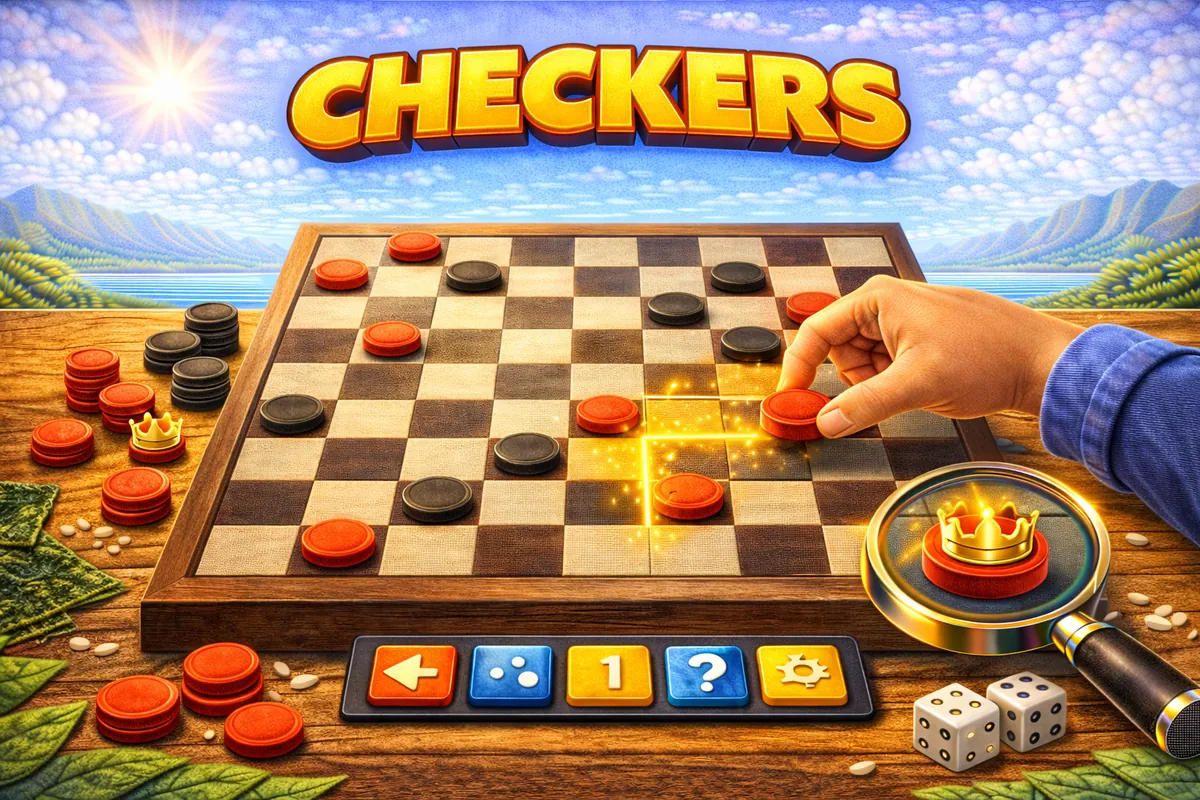
If you can take, you must take. That one rule changes checkers from a game about grabbing pieces into a game about controlling what your opponent is allowed to do — because every capture you offer is a move you have chosen for them.
Which is why good players give pieces away. Put a man where it must be taken, and you know exactly where your opponent's piece will end up. If two of your men are waiting for it there, you have traded one for two and picked the moment yourself.
Count the exchange before you take
Because captures are compulsory, the question is never “can I take this?” It is what happens after I do. Before making or allowing a capture, follow the chain to its end: your take, their forced reply, your reply to that. Most losing moves in checkers are captures that looked free.
The same logic works in reverse and is the single most useful habit to build. When your opponent has a piece hanging, ask why. If taking it puts your man on a square where two of theirs are aimed, the piece was not hanging — it was bait, and the rule that says you must take it is doing their work for them.
When you have a choice of captures, you are not choosing which piece to win. You are choosing which square to be standing on afterwards. Pick the one that leaves you supported, not the one that takes the most.
The rule most people get wrong
A man that reaches the far row is crowned — and its move ends there. It may not immediately continue jumping backwards as a king in the same turn.
This comes up more often than it sounds, because the back row is exactly where jump chains tend to finish. If your man lands on the crownhead with a juicy backwards capture available, it stays where it is. You get the king; you do not get the piece as well. You may jump backwards from the next turn onwards.
Trade when you are ahead, not when you are even
Every even exchange takes both players a step closer to the endgame, where material decides everything. If you are a piece up, that is exactly what you want: trade pieces, keep the extra one, and the advantage grows in relative terms with every swap.
If you are behind, do the opposite. Keep pieces on the board, keep the position complicated, and look for the forced sequence that wins two for one. A crowded board is where compulsory capture does the most damage — and the player who is losing needs that damage to happen.
Kings are worth more than a piece and a half
A man moves one way. A king moves both. That is not a modest upgrade: it roughly doubles the squares a piece influences, and in the endgame a single king can chase down several men that cannot turn round to answer it.
So the back row is worth defending, but not indefinitely. Holding all four of your back squares stops your opponent crowning there and is a real asset early on. It also freezes four of your pieces. Somewhere in the middlegame that trade stops being worth it, and knowing when to release them is most of what separates a strong club player from an average one.
Where players go wrong
Taking because you must, without looking. The rule forces the capture, not the choice of which. When several are available, the choice is the whole move.
Rushing to crown. A man driven up the board alone is usually captured on the way. Kings come from positions, not from sprints.
Trading while behind. Each even swap makes a one-piece deficit worse.
Leaving a man unsupported. A piece with an empty square behind it is a piece your opponent can jump. Advance in pairs.
What was verified on this page
A genuine rules defect was found and fixed. The engine crowned a man the instant it landed on the back row during a jump, and then let it carry on jumping backwards as a king in the same move. Standard rules do not allow that. It was also inconsistent with itself: the code that actually applies a move only crowns a piece if it finishes on the back row, so the illegal extra jump left the piece as an ordinary man. A red man on square 11 was being offered 11x2x9, a double capture that does not exist. It now correctly plays 11x2, one capture, and is crowned.
Move generation was then checked against an independently written generator across 1,174 position-and-colour pairs drawn from random legal play — with compulsory capture both on and off, since the page lets you turn it off. The two agree on every move, every jump chain and every crowning. Applying a move was checked too: the origin is cleared, the piece lands where the move says, and every captured piece is removed.
The engine also correctly treats having no legal move as a loss, which is how checkers games actually end — not by running out of pieces, but by running out of moves.
| Matchup | Stronger side wins | Loses |
|---|---|---|
| Hard (depth 8) vs Medium (4) | 8 | 0 |
| Medium (depth 4) vs Easy (random) | 8 | 0 |
The game that beat its own champion
Checkers has a place in computing history that chess does not. Chinook, developed at the University of Alberta, became the first program to win a world championship title in any game against humans, in 1994. Then in 2007 the same team announced something stronger: checkers is solved. With perfect play by both sides, the game is a draw.
It took eighteen years and roughly five hundred billion billion positions — a number written 5×10²⁰ — making it the largest game ever solved completely. Which is worth holding alongside the fact that the board has 32 usable squares and the rules fit in a paragraph.
More games like this
If you like games where giving something up is the strongest move, try these: