Play Galaxies Online
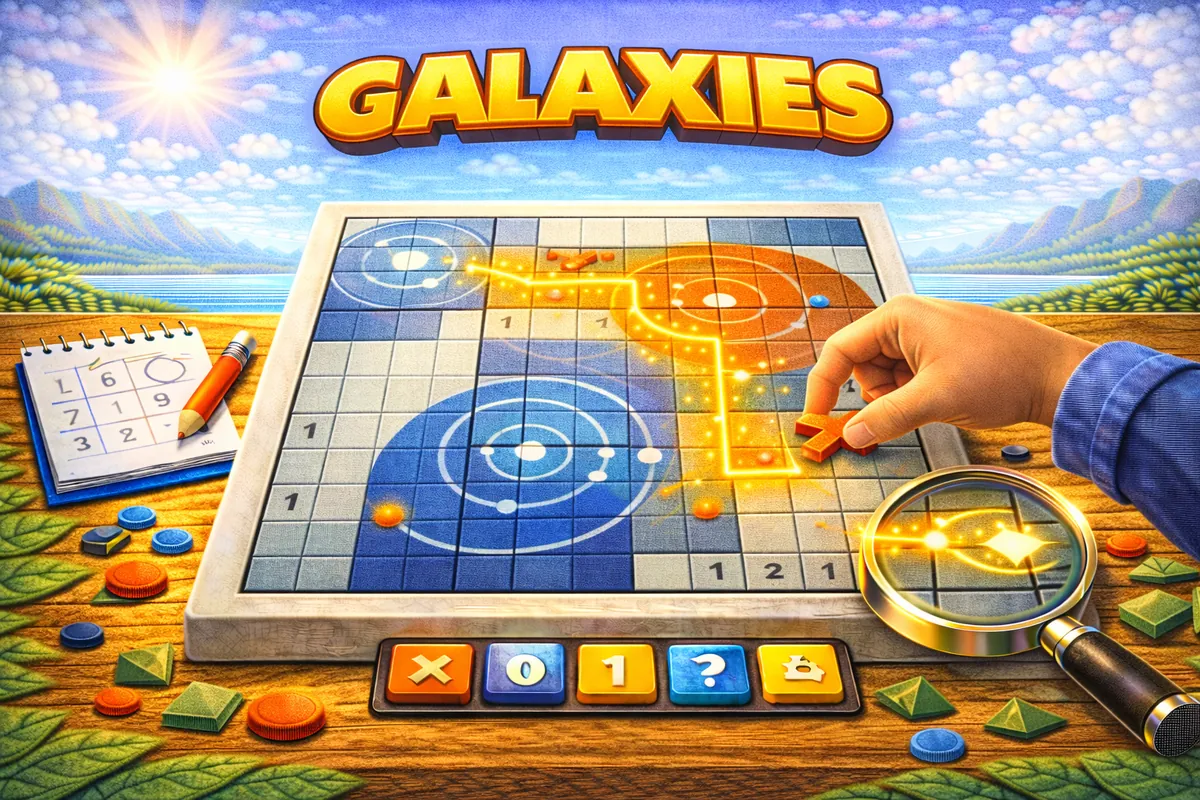
Divide the grid into regions, each containing exactly one galaxy centre. Every region must be 180° rotationally symmetric around its centre.
Created by Brian Hamilton
How to play Galaxies
Divide the whole grid into regions, one for each dot.
- Every region must look exactly the same after a half turn about its own dot.
- Each region is connected and contains exactly one dot.
- Every square belongs to some region.
- Every puzzle has exactly one solution.
Controls: click an edge between two squares to draw or remove a wall.
The dot tells you whether the galaxy is odd or even
Galaxies gives you almost nothing to start with: a grid, some dots, no numbers. But the dots carry more information than they appear to, and one piece of it is free on every single board.
Each region has to look identical when you rotate it half a turn about its own dot, which means its squares pair up — each square with the one directly opposite. The only square that can escape being paired is one sitting exactly on the dot, because it is its own opposite. So:
A dot in the middle of a square means an odd-sized galaxy. A dot on a line or a corner means an even-sized one. Checked across 1,047 galaxies from 96 generated boards, this held every single time, with no exceptions.
About half the dots on a board sit inside a square, so roughly half the galaxies are odd and half are even before you have drawn anything.
| Dot position | Share | What it tells you |
|---|---|---|
| Inside a square | 50% | Odd number of squares; that square is definitely in the galaxy |
| On an edge | 43% | Even; both squares either side are definitely in |
| On a corner | 7% | Even; all four surrounding squares are definitely in |
Every dot hands you free squares
The third column above is the real opening. A dot must lie inside its own galaxy, so the squares it touches are settled immediately — one square for a dot inside a cell, two for a dot on an edge, and four for a dot on a corner.
After that, the rule to lean on is that every square you assign assigns another. Put a square into a galaxy and its opposite number, reflected through that galaxy's dot, joins too. If that reflection lands off the grid, or on a square already taken by a different galaxy, then your original square was wrong. That single test eliminates most possibilities without any further thought.
A worked board
Work outward from the edges and corners. A dot near a wall has far fewer legal shapes, because half its reflections would fall outside the grid — so the boundary is where the board gives most away.
Where solvers get stuck
Forgetting that regions must be connected. Symmetry alone allows a galaxy in two separate pieces. It has to be one connected block, and that rules out a great many otherwise valid-looking shapes.
Leaving a square that no dot can reach. Every square must end up in some galaxy. If a square's reflection through every nearby dot falls off the grid or into another region, something earlier is wrong.
Growing one galaxy at a time. Because assignments come in mirrored pairs, progress on one region constrains its neighbours immediately. Working two or three adjacent dots together is much faster than finishing one and moving on.
Two things you can check about these puzzles
Every puzzle has exactly one solution. Until recently nothing checked this, and boards with more than one answer did ship — two of nine tested at 7×7. The generator now counts solutions before releasing a board and only keeps it when the count is exactly one, treating any search it cannot finish as a failure rather than a pass. 64 boards were then re-checked against a separate counter written from the rules alone; all 64 had a single solution.
Galaxies are now a reasonable size. Earlier boards were made of tiny regions — about 25 of them on a 7×7, averaging under two squares each, which is a pattern more than a puzzle. Regions now average about four squares, with around 13 on a 7×7 and sizes running from 1 up to 18. Grids stop at 8×8 because at 10×10 neither the built-in check nor an independent counter could confirm a single solution in any sensible time.
Galaxies, Tentai Show and Spiral Galaxies
The puzzle is Nikoli's Tentai Show — roughly "star display" — and appears in English as Galaxies or Spiral Galaxies. It is unusual among logic puzzles for having no numbers at all: every clue is a position.
The closest relative here is Shikaku, which also divides a grid into regions around given cells — but there the regions must be rectangles of a stated area, while here they may be any shape at all provided they are symmetric. That trade, a looser shape rule for a stricter symmetry rule, makes Galaxies feel far more visual.
More region-division puzzles
If you like carving a grid into regions, try these: