Play Ataxx Online
The classic territory-control strategy game. Clone and jump your pieces to capture the board. Choose from 8 starting layouts, challenge the AI, or play with a friend.
Created by Brian Hamilton
How to play Ataxx
Take turns moving a piece. Whoever holds the most squares when the board fills wins.
- Move one square in any direction, including diagonally, and your piece is cloned — a copy appears and the original stays put.
- Move two squares and your piece jumps: it leaves the square it came from empty.
- Every enemy piece touching the square you land on is converted to your colour. Only the destination matters.
- Pieces are never removed from the board — only added or converted.
- A player with no legal move passes. The game ends when the board fills or one colour is wiped out entirely.
- On five of the eight starting layouts the number of playable squares is odd, so those games cannot end in a draw.
Controls: tap one of your pieces to select it, then tap a highlighted square to move there. Choose the starting board, your colour, the game mode and AI difficulty above the board.
Every turn is a choice between growing and moving
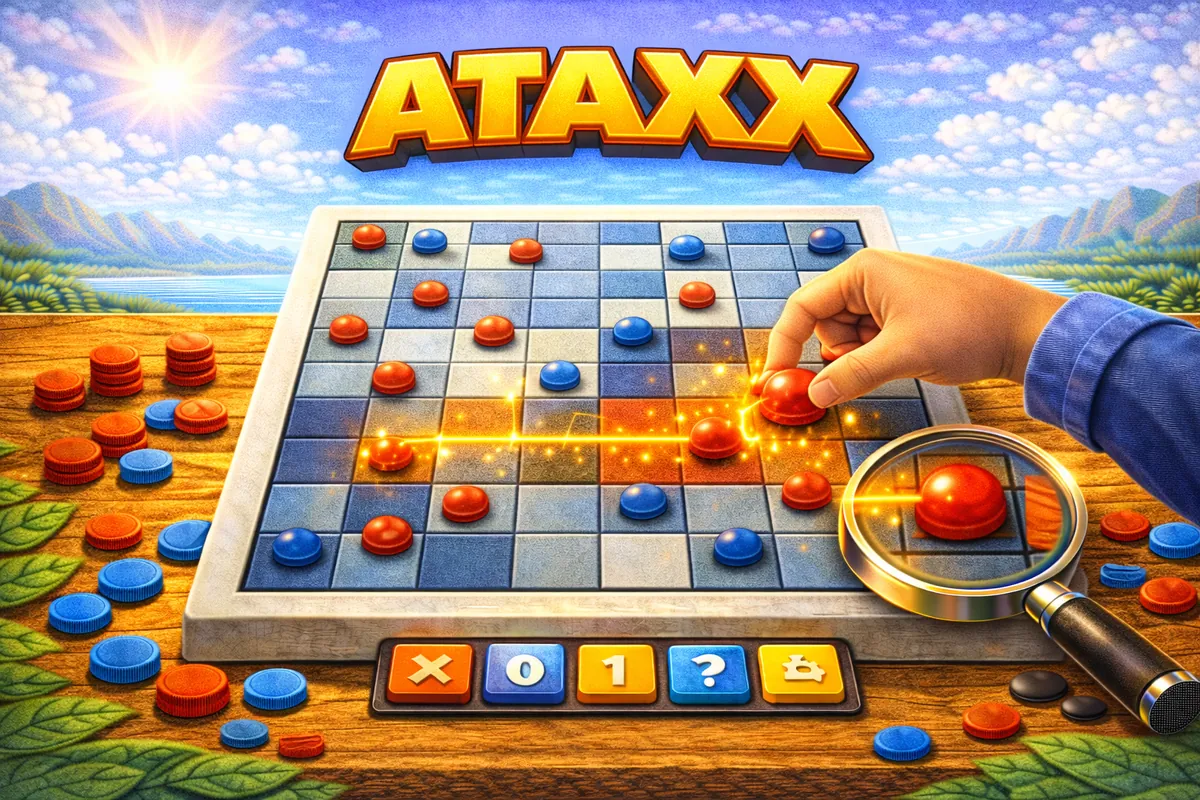
Ataxx gives you two ways to play a piece, and they are not variations on a theme — they differ by a whole piece. Move to a square one step away and the piece is cloned: a copy appears at the destination and the original stays where it was. Move two steps and the piece jumps: it arrives at the destination and vanishes from where it started.
Either way, every enemy piece touching the square you land on switches to your colour. Captures are about the destination only. Nothing about the route matters, and nothing is ever removed from the board — pieces are added or converted, never taken.
This is the single most important thing to understand about the game. A clone leaves you with one more piece than you started the turn with, plus whatever it captured. A jump leaves you with exactly what you captured. A jump that captures nothing is a move that gains you nothing at all, and it opens the square you left.
The rule of thumb that follows: never jump when a clone will do. Jump only to reach ground a clone cannot — a new region, a corner, or a cluster of enemy pieces worth more than the square you are giving up.
Why the corners decide the game
Your pieces are captured when an opponent lands next to them, so a piece's risk is simply the number of squares that touch it. That number is not the same everywhere on the board, and the difference is larger than most players expect.
A piece in the middle of the board can be attacked from eight squares. One on an edge, from five. One in a corner, from three — fewer than half as many. Nothing in Ataxx is permanently safe the way a corner in Reversi is, but a corner piece is the closest the game offers, and a corner is also a square from which your own clones radiate outward without ever exposing a flank behind them.
The squares diagonally next to a corner are the ones to be careful with. Occupying one invites an opponent to clone into the corner beside it, and then you are defending the most valuable square on the board from the wrong side of it. This page's engine scores those squares negatively for exactly that reason.
The layout decides whether a draw can happen at all
The game ends when the board fills or one colour is wiped out. Because pieces are only ever added or converted, a game that ends by filling the board ends with every playable square occupied — so the final score always adds up to the number of playable squares.
That makes a draw a question of arithmetic. Five of the eight starting layouts have an odd number of playable squares, and an odd number cannot split evenly. On those layouts a drawn game is not unlikely, it is impossible.
| Starting layout | Blocked | Playable | Can it be drawn? |
|---|---|---|---|
| Classic | 0 | 49 | No — odd |
| Diamond | 4 | 45 | No — odd |
| Corridor | 4 | 45 | No — odd |
| Walls | 6 | 43 | No — odd |
| Scatter | 6 | 43 | No — odd |
| Cross | 5 | 44 | Yes — 22–22 |
| X-Block | 5 | 44 | Yes — 22–22 |
| Fortress | 5 | 44 | Yes — 22–22 |
On Classic, then, one of you is going to win. There is no safe hedge to play for, and a position that looks level at 24–24 with one square left is already decided by whoever takes it.
Where players go wrong
Chasing the biggest capture every turn. Taking four pieces feels decisive, but if the move that takes them is a jump into open ground, you have handed your opponent a cluster of your pieces to clone back into. Count what the reply captures before you commit.
Spreading thin. A long straggling chain of single pieces touches a great many squares, and every one of those squares is a place an opponent can land to convert several of your pieces at once. Compact shapes give fewer of these openings.
Reading the score too early. A lead in the middlegame means very little, because a single move can convert up to eight pieces — a sixteen-point swing. Ataxx scores are far more volatile than Reversi's, and the game is decided by the shape of the position, not the count.
Ignoring the blocked squares. On the seven layouts that have them, a blocked square is a wall your opponent cannot come through. A piece tucked against one has fewer neighbours, and so fewer ways to be captured — the same logic that makes corners good, available in the middle of the board.
What was verified on this page
The engine on this page was tested against an independent model written from the rules, rather than taken on trust. Move generation was compared on 6,000 random board and colour combinations and matched exactly. The conservation property — a clone adds one piece to the board, a jump adds none, and captures only ever convert — held on every one of 3,824 moves tested. All 400 full games played to a finish, 378 by filling the board and 22 by wiping out a colour, with no game ever reaching a state it could not leave.
Two real defects turned up, and both were fixed. The first was serious: on Hard, the search ran to a fixed depth with no time limit, and on a full middlegame board it locked the page for a median of 38.5 seconds per move, with a worst case over two minutes. The tab simply stopped responding. The search is now bounded by a time budget and hands control back to the page between the moves it considers. A second cap limits any single one of those, because yielding between moves only helps if no individual move takes a long time on its own — one was measured blocking the page for 1.4 seconds. Nothing now blocks it for much over half a second at a stretch.
The second defect was subtler and only showed up once the first was fixed. With every setting capped by the same budget, Hard and Medium were reaching the same search depth — four plies each. They were the same opponent behind two different labels. Ataxx branches very widely in the middlegame, so a fifth ply is expensive: even with two and a half seconds to think, Hard finishes one in only about 7% of positions. The fix had two parts. The move ordering was rewritten to stop copying the whole board for every move it wanted to rank — a capture takes exactly the enemy pieces touching the destination, so they can simply be counted — which bought back a full ply. Then the settings were made honest about what they deliver, rather than advertising a depth the clock never reaches.
| Setting | Time budget | Plies reached | Longest pause |
|---|---|---|---|
| Easy | 0.3s | 2 | 6ms |
| Medium | 0.7s | 3 | 154ms |
| Hard | 2.6s | 4 | 583ms |
A six-game match between Hard and Medium was tried first as a way of settling this, and it gave four wins out of six, then three out of six when it was run again. Six games cannot tell two opponents apart. Counting the plies each one actually finishes answers the question directly, and it is that check which now guards the page.
Easy also plays a random legal move 30% of the time on top of its shallower search, which is what makes it forgiving rather than merely weaker.
A game with a complicated name
The game was designed by Dave Crummack and Craig Galley around 1988 under the name Infection, and reached most players through the 1990 arcade release Ataxx from Leland Corporation. It has been reimplemented and renamed many times since — Frog Feast, Slime, Spot and others — because the rules are small enough to describe in a sentence and the trademark position around the arcade title has always been murky.
Unlike Reversi, Ataxx has never been solved. The 7×7 board with its wide branching factor puts a full solution well out of reach, which is part of why it remains a genuinely interesting game to play against a computer rather than a race to memorise the answer.
More Puzzle & Strategy Games
If you enjoy Ataxx, check out these other games on our site: