Play Order and Chaos Online
An asymmetric strategy game invented by Stephen Sniderman. Order tries to make five in a row — Chaos tries to prevent it. Both players can place X or O. Choose your side!
Created by Brian Hamilton
Order’s turn — pick X or O then click a cell
How to play Order and Chaos
Two players with opposite goals on one grid. Order moves first.
- On your turn, place either an X or an O on any empty square. Neither player owns a symbol — both use both.
- Order wins by making five identical marks in a line, across, down or diagonally. Six in a row counts, because it contains five.
- Chaos wins if the board fills up without any five-in-a-row appearing.
- A completed line wins for Order whoever placed the fifth mark. If Chaos has no safe square left, Chaos must still move — and lose.
- The winning length stays at five on every board size, so the larger grids give Order many more ways to win. 6×6 is the balanced one.
Controls: pick X or O with the mark selector, then tap an empty square. Undo takes back the last move. Choose your side, the grid size and the opponent — three AI levels or a second player — above the board.
Both players use both marks
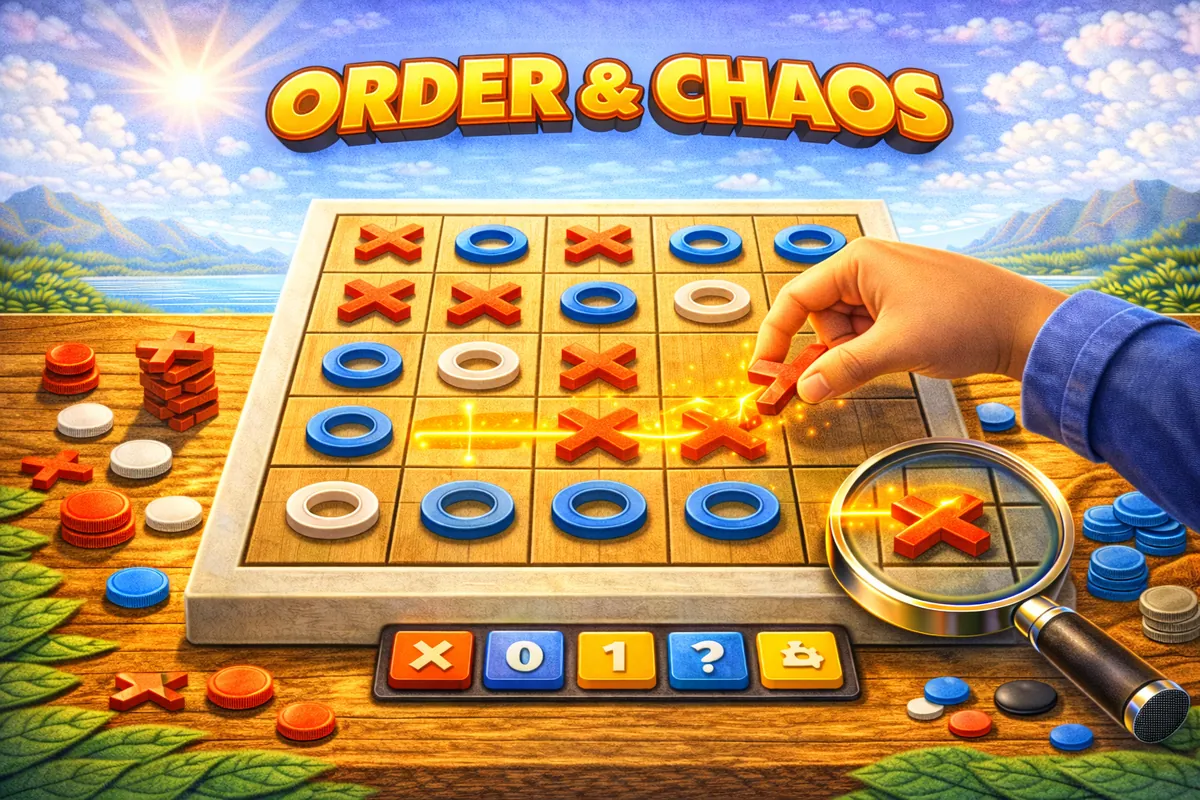
This is the rule that makes Order and Chaos its own game rather than a tic-tac-toe variant, and it is the one that takes longest to sink in. There is no "your symbol". On every turn, either player may place either an X or an O on any empty square.
Order wins by making five identical marks in a line — across, down or diagonally. Chaos wins by filling the board without one ever appearing. Order moves first.
So defending is a choice of two things, not one. Chaos has to find the square that matters and put the right symbol on it. Playing the correct square with the wrong mark hands Order the game. It is the most common way a beginner loses as Chaos, and it does not exist in any other game on this site.
It cuts the other way too. Order is never committed to a symbol: a run of three X and a run of three O are both live threats, and Order can switch between them freely. Counting only one symbol's chances will badly underestimate the danger.
Chaos cannot block, only prevent
Blocking is a losing strategy for Chaos, because Order can build a threat that has two answers and Chaos only gets one move.
Four in a row with both ends open is not a threat — it is a finished game. Chaos occupies one end and Order plays the other. The same applies to any shape with two separate completing squares, which is why a fork is the thing Order is really aiming at and the thing Chaos must see coming several moves early.
The practical rule for Chaos: react to threats and you will lose. Chaos has to spend moves on squares that look harmless, breaking up the space where a double threat could later form — especially the middle, where lines cross most.
The board size changes the game completely
The game offers 6×6, 7×7 and 8×8, and the number of marks Order needs stays at five on all of them. That single fact decides everything about the balance, and it points the opposite way from what most people expect.
A 6×6 board holds 32 possible lines of five across 36 squares. An 8×8 holds 96 across 64 — from 0.89 lines per square to 1.50. Extra room gives Order strictly more ways to win, and gives Chaos no new way to stop them: Chaos still gets exactly one mark per turn.
Playing the page's own AI against itself confirms it. With both sides on Hard, Order won 21% of games on 6×6, 29% on 7×7 and 93% on 8×8. On Medium the same pattern is starker still: 57%, 93%, then 100%.
6×6 is the real game. The bigger boards are worth a look for the shape of the play, but they are close to a formality for Order. If you want a contest, stay on the standard board.
Playing each side
As Order: work in the middle, where the most lines cross. Build shapes that threaten in two directions at once rather than extending a single run — a run Chaos can see is a run Chaos can break. Remember that you may switch symbol at any moment, so a scattering of both marks can be closer to a fork than it looks.
As Chaos: alternate. The single most effective habit is to place the mark that is not already dominant in whatever region you are playing in, which spoils runs before they are runs. Prefer squares that sit on several potential lines at once, and take the centre early, for the same reason Order wants it.
As either: the corners and edges are cheap. On the standard board a corner square sits on far fewer lines of five than a central one, so a mark placed there does much less — for both players.
What was verified on this page
Win detection was compared against an independent scan written from the rules on 18,000 random boards at all three sizes, and matched every time. Every line it reported was checked to be five identical marks, evenly spaced in one direction. Six in a row correctly counts as a win, because it contains five; four does not, and neither does a line of five with one symbol out of place.
The rule people misremember also holds: a five-in-a-row wins for Order whoever places the fifth mark. If Chaos has no safe square left, Chaos must still move, and completing a line loses. All 600 test games reached a proper result.
One claim on this page was wrong and has been corrected. The article previously said that the larger boards make the game "progressively harder for Order". Both the geometry and the measured games say the opposite, and by a wide margin. The old text has been replaced with the numbers above.
| Board | Lines of five | Per square | Order wins (Hard) |
|---|---|---|---|
| 6×6 | 32 | 0.89 | 21% |
| 7×7 | 60 | 1.22 | 29% |
| 8×8 | 96 | 1.50 | 93% |
The three difficulty settings are genuinely different opponents. Put each in the Chaos seat against a Hard Order on 6×6: Easy survived an average of 8.5 moves and never won, Medium lasted 35 moves and won 10 of 12, and Hard filled the board every time, winning all 12. Choosing a move took at most 518ms, on the largest board.
An honest note about the computer opponent. Order is known to have a forced win on 6×6 with perfect play. This page's AI does not find it — playing itself, its Order side wins only about a fifth of the time on that board. Executing Order's theoretical win needs far deeper calculation than a browser game does in a fraction of a second, so on the standard board you will find Chaos the easier side to take. That is a limitation of the opponent, not of the game.
A game with one rule too many
Order and Chaos was invented by Stephen Sniderman in 1981, and its whole design is one departure from noughts and crosses: unbind the players from their symbols. Everything else — the asymmetric goals, the fact that one player is trying to prevent rather than achieve — follows from that single change.
It belongs to a small family of genuinely asymmetric abstract games, where the two sides are not merely playing different colours but pursuing different kinds of goal. Games of this shape are unusually hard to balance, and Sniderman's solution — give the harder job to the player who moves first — is why the standard board is 6×6 and not something roomier.
More Strategy Games
Enjoy Order and Chaos? Try these other free games: