Play Tents and Trees Online
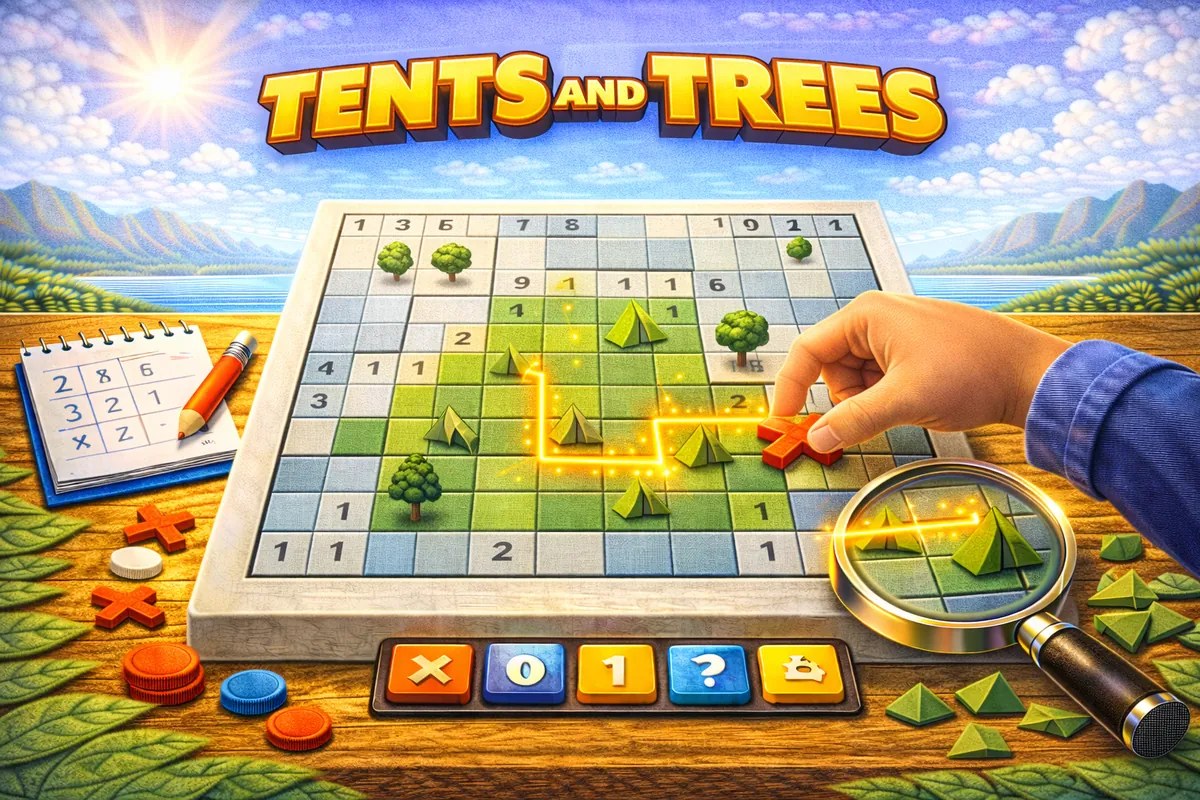
Place a tent beside every tree so that no two tents touch — not even diagonally. Row and column numbers are your only clues.
Created by Brian Hamilton
How to play Tents and Trees
Pitch one tent beside every tree, so that the numbers around the edge are satisfied.
- Every tree is paired with exactly one tent directly above, below, left or right of it — never diagonally.
- Every tent belongs to exactly one tree, so there are as many tents as trees.
- No two tents may touch, not even at a corner.
- The numbers give how many tents belong in that row or column. A 0 means none.
- Tents may sit next to other trees; only the pairing has to be one to one.
Controls: click a square to cycle it between a tent, a cross for ground you have ruled out, and empty. Marking the crosses is what makes the next deduction visible.
The opening move everyone teaches almost never applies
Every Tents and Trees guide starts the same way: find a tree with only one free square beside it, and put its tent there. It is sound logic. It is also, on these boards, close to useless as an opening.
Counting across generated puzzles, the number of trees hemmed in to a single free side is tiny — usually none at all.
| Board | Trees | Boxed-in trees | Lines with a clue of 0 |
|---|---|---|---|
| 8×8 | 8 | 0.0 | 4.5 |
| 8×8 | 12 | 0.3 | 2.8 |
| 10×10 | 14 | 0.0 | 3.5 |
A tree in open ground has four free sides, and trees are scattered rather than packed, so being reduced to one is a rarity. Waiting for that pattern means staring at a board that will not move.
The zero clues are the real opening, and there are several on every board. A row or column marked 0 contains no tents at all, which lets you strike out an entire line in one stroke — and every square you eliminate takes a side away from the trees touching it. That is what manufactures the boxed-in trees the guides tell you to look for.
Start with the zeros, then the arithmetic
The order that actually works on these puzzles is: strike out the zero lines, then count.
Zeros first. Cross off every square in every line clued 0. This costs no thought and is pure gain.
Then look for lines that are already full. A row needing two tents that has only two possible squares left is finished. This is the counting deduction, and after the zeros have been struck out there are usually several waiting.
Then the boxed-in trees — which by now genuinely exist, because your eliminations created them.
A tent is bigger than it looks
The no-touching rule is the one that shapes the board. Two tents may not be adjacent, and that includes diagonally — so placing a tent takes its own square out of play along with all eight around it.
A tent in open ground accounts for nine squares: itself plus the eight it forbids. On an edge that falls to six, and in a corner to four.
The practical consequence runs the other way round. A row clued with a large number needs its tents spread out, because each one sterilises its neighbours — so a high clue on a short row is far more restrictive than it first appears, and often has only one legal spacing.
Every tree gets its own tent
This is the rule that separates Tents and Trees from ordinary placement puzzles, and the one most often applied loosely. The pairing is one to one: every tree is matched with exactly one tent beside it, and every tent belongs to exactly one tree.
So a tent adjacent to two trees is not automatically wrong — but it can only serve one of them, and the other still needs a tent of its own from somewhere else. Equally, the number of tents on a finished board always equals the number of trees, which makes the row and column clues add up to the tree count. That is a free check on your arithmetic before you start.
Where solvers get stuck
Pairing greedily. Putting a tent next to the first tree that will take it often strands a tree further along with nothing left. When two trees compete for the same square, work out which one has another option before committing.
Marking tents but not grass. Squares you have ruled out are what drive the puzzle. Crossing them off is not tidying up — it is how the next deduction becomes visible.
Forgetting the diagonal. Two tents touching at a corner is the commonest illegal position, because the eye reads a diagonal gap as a gap.
Two things you can check about these puzzles
Every puzzle has exactly one solution. A candidate board is handed to a solver that counts arrangements, and the board is discarded unless there is precisely one. The count also has to complete — if the solver runs out of steps without finishing, that no longer counts as a pass, so a puzzle is never accepted merely because it was too big to check.
The clues always sum to the number of trees. Add the row clues, then add the column clues: both totals equal the number of trees on the board, because the pairing is one to one. If your own arithmetic disagrees, you have miscounted somewhere — it is the cheapest sanity check the puzzle offers.
Tents and Trees, Camping and Tentai
The puzzle appears as Tents and Trees, Tents and Camping in English collections. It is a pairing puzzle rather than a shading one: the interesting constraint is the one-to-one matching between trees and tents, which is what stops it collapsing into a simple counting exercise.
The no-touching rule is shared with Queens and Star Battle, where placed pieces also forbid their eight neighbours. What Tents adds on top is that each piece must be assigned an owner.
More placement puzzles
If you like fitting pieces under a no-touching rule, try these: